Blog
CS Foundation Subjects 2026: Difficulty Level & Preparation Order

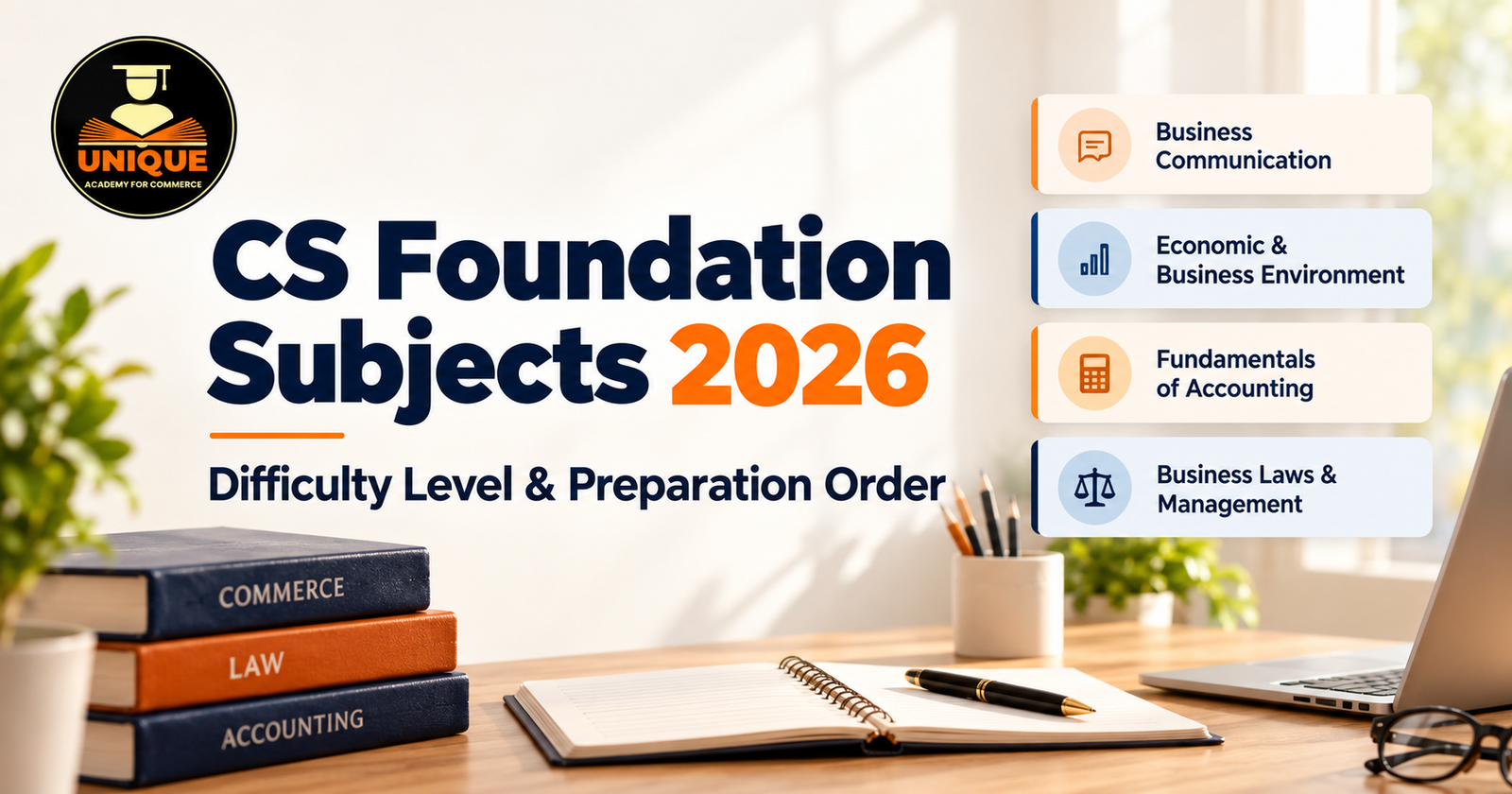
Choosing how to begin can cause much more hesitation than the preparation itself. When planning for CS Foundation Subjects 2026, students preparing for CSEET often wonder which subject they should start with and which one requires the most attention. With the 2026 pattern spreading four papers across four separate exam days, choosing the right preparation order becomes even more important.
In this blog, we rank the difficulty level of all four CS Foundation Subjects 2026 and suggest a practical preparation order while keeping in mind that every student has different strengths and weaknesses.
Why It’s Important To Consider the Sequence While Preparing For CS Foundation Subjects In 2026 ?
Earlier, with the CSEET pattern, all the four subjects used to appear together in a computer-based two-hour test. The candidates could move between the sections at will, thus not really making it necessary to consider which comes first.
However, with the new pattern, the sequence of subjects becomes important to follow in preparation. This is because the three subjects that follow the first subject will be attempted in separate exams in separate days and it might become difficult to retain the momentum built for one subject for the other.
Furthermore, three of the papers are subjective while one remains objective, which means that your mind has to keep shifting between the answer writing mode and MCQ solving mode. Thus, planning a sensible sequence helps keep the confidence as well as the mental adaptability intact during preparation.
What Are the CS Foundation Subjects 2026?
The difficulty differs with each individual’s background, though there are some common trends.
Fundamentals of Accounting is the most difficult for non-commerce candidates, because of its numeric nature and inclusion of journal entry, depreciation, and final accounts that require previous knowledge. For commerce background students, this is one of the easiest papers.
Business Laws and Management occupies a medium position. Though the legal terminologies may seem foreign at first, the objective nature of this paper with no negative marking helps a lot during exams.
Economic and Business Environment is also a moderately difficult paper, since it consists of conceptual economics along with a general understanding of businesses. Students who frequently read about business news find this easier than others.
Business Communication happens to be the easiest paper among the four for most students, especially those good in English writing. However, candidates less certain of their capabilities in written expression may need correspondingly more practice in this regard, considering how the subject’s reputation may not do it justice.
Visit Unique Academy For Commerce for more CS Foundation Updates
What is the ideal order of preparation of CS Foundation Subjects In 2026?
Beginning with Business Communication is good for most candidates, considering the confidence boost from doing well in an introductory paper. Having good writing skills will also come in handy when it comes to the other subjective papers, in view of the requirement of proper answer presentation.
Economic and Business Environment is next, and it will help the candidate maintain the conceptual flow built up from the previous paper, while also maintaining the writing skills gained in the previous subject because of its descriptive nature.
Fundamentals of Accounting should come in mid-preparation because of its high requirement of practice, especially for those without a commerce background. This timing allows enough practice before approaching the time of examination, which is more important for this subject because of its numerical nature.
Concluding preparation with Business Laws and Management is quite reasonable considering its objective format, which allows easy MCQ practice before the final stage of examination. This approach will also provide your brain with a unique experience right before the exams, which many students appreciate after weeks of descriptive exercises.
Adjusting the Order Based on Your Educational Background
The above-described pattern can serve as a good starting point but not everyone will require the same adjustment based on his or her educational background. If you were a commerce graduate or even just enrolled in the current year of your studies, you should seriously consider moving the Fundamentals of Accounting ahead, since your previous experience will significantly reduce the learning curve.
If, for example, you had Political Science or Legal Studies at the higher secondary level, you would probably find Business Laws relatively easy and move it earlier in your schedule accordingly. Understanding your comparative advantage, instead of following the order strictly, will result in a much better outcome than strict adherence to someone else’s advice.

How to Balance Time Spent on All Subjects
As mentioned above, all four papers have equal weightage of 100 marks. In addition, passing the examination requires getting 40% in each individual paper regardless of overall performance. That means that spending disproportional amount of time on your favourite subject and neglecting the other one can be risky.
A remarkable grade in Business Communication can’t make up for not meeting the threshold in Accounting.
Equal distribution of weekly preparation hours among all four subjects, despite following the mentioned order of introduction, avoids the issue of imbalance. Many candidates that pass CSEET begin studying two subjects simultaneously when the preliminary exposure to the first one ends, instead of finishing one subject completely before switching to another.
Final Words
There’s no perfect sequence to prepare for all CSEET subjects with the new syllabus – individual educational background changes the perception of difficulties for different subjects. Preparing in the following order: Business Communication, Economic and Business Environment, Fundamentals of Accounting, and finishing with Business Laws and Management is a good default option for most students.
Personalizing the preparation order according to your comfort zone while making sure no subject gets forgotten because of the individual 40% threshold will do much better.
FAQs
The Fundamentals of Accounting is considered to be the toughest for the majority of the candidates, especially for those who don’t have a background in commerce due to its numerical and procedural nature. However, difficulty is also subjective in nature, and some students may consider Economic and Business Environment equally difficult based on their reading styles. It will help you assess your comfort level by taking an informal diagnostic test at the very beginning of preparation.
No, because there’s no need to follow the order of examination days and preparation days. It’ll be easier for you to develop your comfort zone in a more familiar subject, irrespective of the day in which it’s being tested. More important is covering all four subjects before the examinations arrive.
No, because the nature of the Business Laws and Management paper being objective type means you can revise it fairly quickly. The majority of students prepare for this paper towards the end because of its ease after revising for other three papers. Don’t rush the last few days to cover everything.
It is not recommended to do so since commerce students have the option to study this topic earlier due to their knowledge about this topic. Despite having good knowledge regarding it, revising it according to the syllabus of CSEET and the type of questions will be very helpful. Not considering any topic necessary to revise will be risky due to individual 40% passing criteria.
There is no specific number but giving almost equal time to all four subjects per week is usually sufficient as they carry the same weightage of 100 marks. Those students who are weak in some specific topic may give more time to it while not neglecting other topics.