Blog
CS Foundation Course Details: Complete Guide for 2026–27

Fresh pass outs from Class 12 and exploring the Company Secretary journey are entering into a unique phase. The ICSI has come out with the exposure draft of its proposed Syllabus 2027. Aspiring candidates planning their CS Foundation journey in 2026-27 need to know both the current structure and the proposed changes in equal measure.
This blog explains the existing entry structure, the proposed Foundation papers and the implications of this shift for new aspirants.
CS Foundation Course: What Is the Current Entry Route?
For students planning the CS Course After 12th, it is important to understand the current syllabus structure. The existing Syllabus 2022 is applicable for CSEET, the Executive Programme and the Professional Programme. The Council of ICSI approved it in its 287th meeting in August 2022.
The said syllabus came into force from June 2023 for CSEET, February 2023 for Executive and August 2023 for the Professional programme.The Council approved a restructure of CSEET in its 322nd meeting held in November 2025. The restructured version came into force from December 2025.
Hence, students registering now still have CSEET as the entry route and not the Foundation programme.However, things seem to look differently going forward, and this is what the Syllabus 2027 exposure draft is all about.
Changes proposed by the Syllabus 2027
As per the exposure draft, the CS course is expected to undergo three stages – Foundation, Executive and Professional stages. The introduction of the named Foundation Programme marks the shift from the existing CSEET-based entrance.
There are several objectives behind the proposed revision, including bringing the syllabus in line with regulations, eliminating obsolete or redundant portions, and integrating the experiential learning component. Incorporation of AI technology in relevant papers and harmonisation with the National Education Policy 2020 are also significant.
Remember that it is just an exposure draft released by the Council of ICSI. Nothing in the above is final until the Council officially notifies.
Visit Unique Academy For Commerce for more CS Foundation Updates
Proposed Structure of the CS Foundation Programme
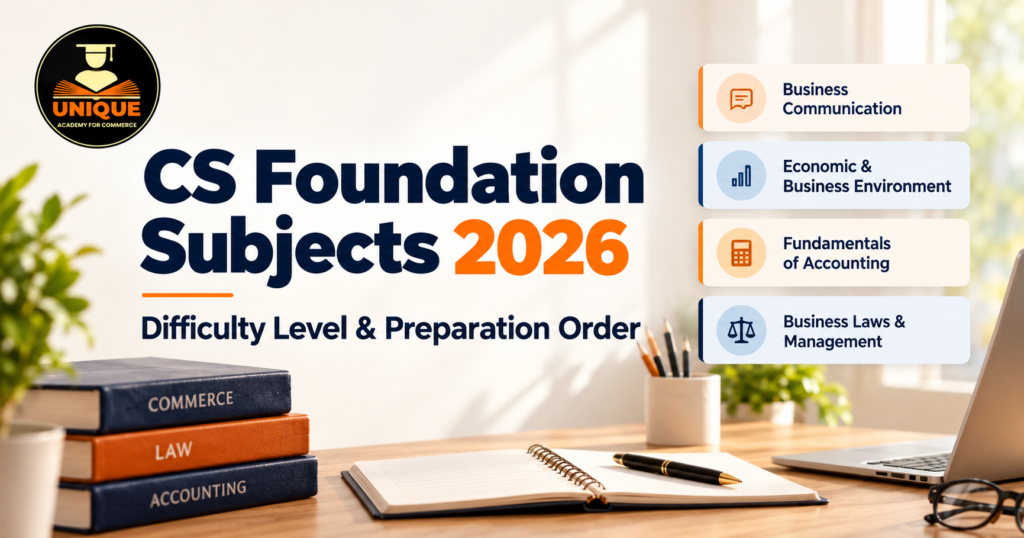
Four papers are proposed at the Foundation Stage, each carrying 100 marks.
The first paper is Business Communication in AI Era or alternatively named as ‘Business Communication – Practice and Emerging Technologies’. The scope covers basics of communication, business correspondence, reading comprehension, presenting skills, and the use of AI tools in business communication.
The second one is Fundamentals of Accounting, comprising accounting basics, bank reconciliation, depreciation, final accounts, partnership and LLP accounts, and a newly proposed topic ‘accounting in the digital era’.
Third is Economics and Business Environment, equally split into Economics and Business Environment, 50 marks each. The more recent inclusions include money markets, digital economy, digital public infrastructure, and emerging business environment.
Fourth is Business Laws and Management. Internal weightage in this subject is to change from 60:40 to 80:20 in favour of Business Laws. The Management part is to cover basics and key functions of planning, organizing, staffing, directing, and controlling.
Experiential Learning and 70:30
A notable change in this regard relates to the manner in which the students are to be evaluated. As against just relying on written examinations, the draft recommends a weightage of 70% for written papers and 30% for experiential learning, relevant to all Foundation, Executive and Professional stages where necessary.
The internal evaluation process may comprise online/AI-assisted tests using LMS, assignments/web based, projects, presentations or practicals including visits to courts, among others. The intention is clear – ICSI wants the candidates to learn and get exposed continuously, rather than just focussing on a single exam.
There is a proposed change in the method of grading system in order to balance both written and internal evaluations.
Examination Mode in Draft Scheme
It has been recommended that descriptive examinations be conducted for each paper for both Foundation and Executive stages. This is significantly different from a multiple choice entrance test because here the candidate needs to develop the skill of answering questions right from the beginning.
At the Professional stage, it has been proposed that the mandatory papers would follow a descriptive examination mode while the elective papers would follow an open book examination.
Preparing for open book examinations involves application of concepts and not mere memorization of topics.
Any student who joins now would benefit from developing the skill of writing answers right from the beginning, irrespective of whether the mode of examination proposed would apply to them or not.
After Passing CS foundation what’s next?
Passing the entry stage results in entering the Executive Programme where one would study seven papers in two groups. Group I includes the subjects Jurisprudence, Interpretation and General Laws, Company Law and Practice, Setting up of Business and Intellectual Property Laws and Corporate Accounting.
Group II comprises the subjects Capital Market and Securities Laws, Economic, Commercial and Labour Laws and Tax Laws and Practice. It is pertinent to highlight the proposed transfer of Intellectual Property Laws from ECIPL to the Setting up of Business paper, with Labour Laws taking its place in Part II.
Post Executive comes the Professional Programme, or the Governance and Strategic Leadership Programme as per the draft, covering papers on governance and sustainability, digital governance and AI, advanced company laws, along with two electives.
Final Thoughts for Students Planning CS Foundation
Taking up the CS course right after Class 12 continues to provide a real head start as you kick off your professional qualification when peers are still in college. However, the nature of this entry point is likely to change with a Foundation Programme, descriptive examinations, and experiential learning in the ICSI syllabus proposal.
FAQs
No, the CS Foundation Programme is only in an exposure draft format prepared by ICSI for discussion with stakeholders. It is possible for there to be differences between the draft and the final notification, which should be the primary guide for any CS aspirant to take a decision regarding registration.
Waiting endlessly till the time a draft comes up as the final syllabus is not something to do. It is always better to join the present system and start studying and then see the ICSI guidelines whenever there is a change in syllabus. You can check for the same on the official website of ICSI.
There would be two main changes proposed in the syllabus – one would be the introduction of the named Foundation Program which will have four papers altogether and then the second one is that all foundation exams will be in descriptive format.
As per the syllabus draft, 30% of weightage would be based on experience and not the written paper alone. Some of the methods that have been suggested for the same would be the AI-assisted tests, through the learning management system, project work, presentations, web-based assignments and practicals such as court visit.
The students who are already enrolled remain on the syllabus relevant to their enrollment until the ICSI makes a notification in writing. In the past, whenever there has been a change in the syllabus, the institute has made such notifications about changeover and cut off sessions.