Blog
All About CA Foundation Exam 2027: Exam Form Dates, Pattern, Syllabus

A quick heads-up before we dive in: ICAI (The Institute of Chartered Accountants of India) hasn’t released the final, official notification for every 2027 attempt yet. Anything marked “expected” below is based on ICAI’s established pattern from recent cycles, not a confirmed date. Always cross-check with ICAI closer to the attempt.
What exactly is the CA Foundation exam, and why does the date matter so much?
The CA Foundation is the entry gate into the Chartered Accountancy course in India. It’s the first of three levels (Foundation, Intermediate, Final), and it’s where most CA aspirants take their very first shot at a professional exam. Getting the date wrong, or missing a registration window by a few days, can push your entire CA timeline back by four to five months.
How many times a year is the CA Foundation exam actually held?
Since the New Scheme kicked in with the June 2024 session, ICAI moved from a twice-a-year format to three attempts annually. You now get a shot in January, May, and September each year.
So, when is the CA Foundation examination scheduled to take place in 2027?
Given the current system of conducting three exams per year, here’s what the practical scenario looks like:
- 2027 January attempt – scheduled for the first half of January as per the trend followed by ICAI in earlier January examinations.
- 2027 May attempt – scheduled for the first or second week of May as per the trend seen in earlier sessions.
- 2027 September attempt — expected in early-to-mid September, continuing the established rhythm.
None of these are locked-in dates yet. ICAI typically drops the official exam notification (with the paper-wise date sheet) somewhere between 60 and 90 days before the attempt.
When does registration close for the January 2027 attempt?
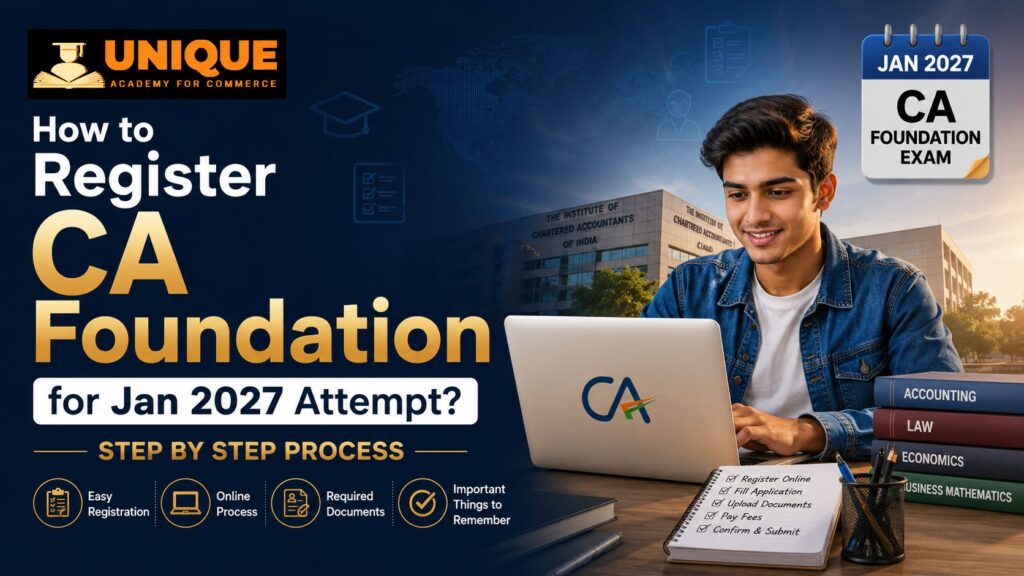
This is one of the most searched questions right now, and here’s the honest answer: ICAI requires you to register with the Board of Studies at least four months before the first day of the exam month. Practically, that puts the January 2027 registration cutoff around 1 September 2026. If you’re eyeing this attempt, don’t wait until August to start the process — document verification, photo uploads, and payment glitches eat up more time than people expect.
What about the exam form — is that different from registration?
Yes, and this trips up a lot of first-timers. Registration and the exam form are two separate steps:
- Registration — a one-time process where you enroll with the Board of Studies. This is what needs to happen four months before your target attempt.
- Exam form — filled out separately for each specific attempt, closer to the exam date. For the January cycle, ICAI usually opens the exam form window in November, roughly six to eight weeks before the papers begin.
Think of registration as enrolling in the course and the exam form as booking your seat for a particular sitting. You need both, and missing either one means you’re not appearing that cycle.
If you wish to kickstart your CA journey, and want to know All About CA Foundation Exam 2027 then join Unique Academy For Commerce without second thoughts.
How much does CA Foundation registration cost?
For Indian students, the registration fee currently sits around ₹9,200, while overseas candidates pay roughly $700.
Who is eligible to sit for CA Foundation?
You qualify if:
- You’ve passed (or are currently appearing in) your Class 12 board exam under a recognized education board, or
- You’ve cleared Class 10 and want to go through provisional registration while your 12th results are pending.
There’s no minimum percentage requirement to register for Foundation — that condition only applies if you’re trying to skip Foundation entirely through the direct-entry route after graduation.
What’s the exam pattern like?
CA Foundation tests you across four papers, 100 marks each, adding up to 400 total marks:
| Paper | Subject | Type | Duration |
| Paper 1 | Accounting | Descriptive (subjective) | 3 hours |
| Paper 2 | Business Laws | Descriptive (subjective) | 3 hours |
| Paper 3 | Quantitative Aptitude | Objective (MCQ) | 2 hours |
| Paper 4 | Business Economics | Objective (MCQ) | 2 hours |
A couple of things worth knowing:
- Papers 1 and 2 are written papers— no negative marking.
- Papers 3 and 4 are MCQ-based, and each wrong answer costs you 0.25 marks.
- To pass, you need a minimum of 40% in every individual paper and 50% in aggregate across all four (that’s 200 out of 400).

What does the syllabus actually cover?
Here’s a paper-by-paper summary:
Paper 1: Accounting – Accounting, journal entries, ledger posting , trial balance and final accounts.
Paper 2: Business Laws – There are topic such as Contract Act, Sale of Goods Act, Partnership Act, Companies Act format and other business laws.
Paper 3: Quantitative Aptitude – Mainly covering Ratios, algebra basics, stats, logical reasoning, APGP etc.
Paper 4: Business Economics – Theory of Demand supply, cost concepts, money and banking, etc.
What should I be doing right now if I am preparing for Jan 2027 or May 2027?
A realistic month-by-month approach works better than cramming later:
- Now through the registration deadline: Get registration out of the way early. Don’t let paperwork be the reason you miss an attempt.
- Once registered: Start with Accounting and Business Laws — these two need the longest runway because they’re syllabus-heavy and practice-driven.
- Two to three months out: Bring Quant and Economics into daily rotation alongside revision of the first two subjects.
- Last 2 weeks: Revision only; no new topics. It is at this stage that working out old papers under time constraints becomes more important than studying fresh material.
Frequently Asked Questions
Yes — registration is valid for four years. If you miss the January exam form window, just fill it for May instead.
No there are no new changes as of now only dates will be updated as and when notified by ICAI .
You won’t be eligible for that attempt the four-month rule is strict, with no late-fee workaround. You’d aim for May 2027 instead.
Yes. There’s no paper-wise carry-forward — you must clear all four together (40% each, 50% aggregate) or reattempt all four next cycle.