Blog
CSEET Business Laws and Management: Preparation Guide

Business Laws and Management is one of the four papers that you must clear in the CSEET examination. This paper can surprise students since it combines two completely different concepts. Business laws will test your knowledge in legal provisions along with terminologies used in business while management will cover topics relating to organizational behaviour and administrative science. It is possible to get stuck in between these two sides of the paper without an effective preparation strategy.
In this blog post, we will discuss the step-by-step process of studying for the CSEET paper of Business Laws and Management in the most efficient way.
First Understand the Weightage Allocation of Each Half of the Paper
When preparing any paper in the CS course, it is important to know the weightage distribution between different concepts. Similarly, in Business Laws and Management, the first thing you must do is know the approximate weightage allocation of the two sections in the CSEET paper. Go through the weightage as given by ICSI.
By referring to the ICSI CSEET curriculum, you will get an idea of which topics come under business laws and which topics belong to the management section. Once you know the weightage chapter wise it will become extremely easy to allocate study time in the required proportions.
Differentiate Between the Two Halves
Laws usually have definitions, provisions and legal terminologies which one must remember accurately. Management has more conceptual aspects as well as theories which should be applied practically.
An identical study technique rarely works for both parts. Legal provisions must be read repeatedly and notes prepared accordingly while management theories can be better understood through case study and real-life examples. This understanding will prevent wastage of efforts on inappropriate study methods.
Start With Basic Business Laws
Since business law acts as the base for many CS Executive and Professional subjects in future, a good preparation of this subject in CSEET will be of immense help in the coming years. Start with fundamental concepts like law, sources of law and basic constitutional provisions before moving to specific acts.
After getting familiar with the above fundamentals, move to the basics of company law, contract law and other statutory provisions as per the syllabus. The sequencing of topics mentioned above will ensure that you follow a logical flow of topics instead of hopping from one unrelated legal topic to another.
Visit Unique Adacemy For Commerce for more CSEET Related Updated
Relate Topics to Real Life Examples While Studying Management
When reading management concepts like planning, organizing, staffing, directing and controlling, they may seem abstract as they are just textbook definitions. Relating them to real-life situations, like how a small business owner plans inventory or distributes tasks, will make it much easier to remember them.
Similarly, concepts like leadership styles and motivation theories can be understood easily when related to common workplace experiences, instead of only remembering their definitions.
Connect Realities and Management Theories in Your Learning Process
It is beneficial to create this habit of relating realities with theoretical concepts as it will help to grasp them conceptually.
Maintain Two Sets of Notes for Legal Definitions and Theoretical Concepts Respectively
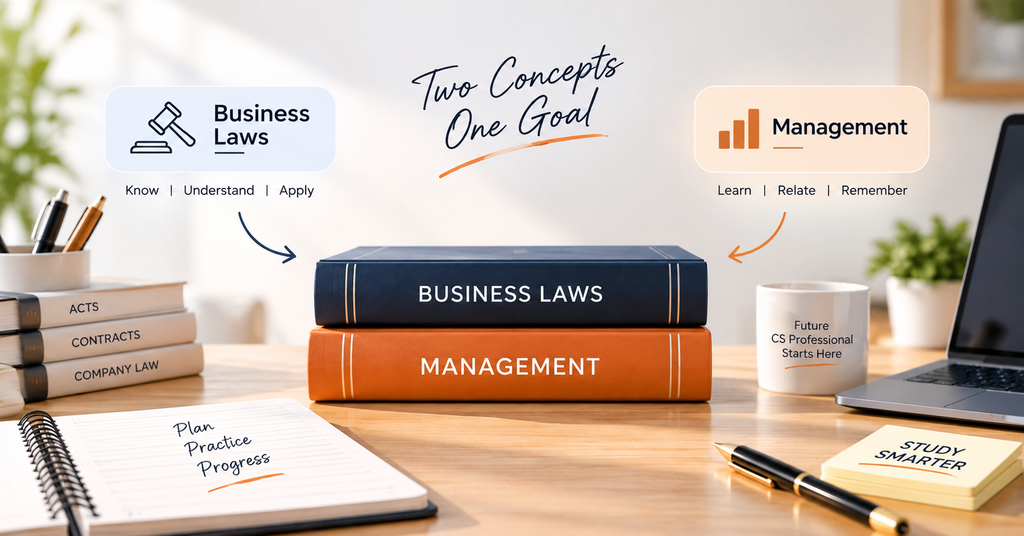
Due to the very nature of this subject, maintaining two sets of notes is recommended. One set should include legal definitions, sections and provisions verbatim as business laws questions may test your vocabulary in this regard. The second set should include summaries of theories in simple language.
Having separate notes for these two different parts of the subject will prevent confusion while revising as the exam approaches. The use of color codes or separate notebooks for each half could add another way to distinguish the two parts from each other.
MCQs Practice Should Be a Part of Your Preparation Since CSEET Is Objective
Whereas CS exams involve writing descriptive answers, the objective format of the CSEET requires a completely different approach to preparation. It means that just knowing the material won’t do since you have to recognize the right answer under time pressure.
Practicing solving MCQs since the very beginning of your preparation will help you to become familiar with how the questions are posed. Besides, the analysis of wrong answers after each practice will help to identify any recurring misconceptions that you need to sort out before the exam day.
Familiarize Yourself With Frequently Asked Questions
There are certain topics of the business laws where questions recur in every attempt, and the same holds for management subjects. Thus, the analysis of the previous CSEET or sample questions will help you identify the themes which require your attention.
Focusing too much on the niche topics which are rarely asked and neglecting the frequent ones is not the most effective way of spending your limited time.
Mock Tests Under Realistic Conditions
In the final stretch leading up to the exam day, mock tests will prove to be the best way to build your speed and accuracy in solving the objective questions in Business Laws and Management for CSEET. The reason for this is the time limit for the entire paper. Attempting these mocks will ensure you are well acquainted with the online testing platform and will prevent unnecessary tension on the D-day.
To end our Blog
The preparation of Business Laws and Management for CSEET does not have to be as difficult and scary as it might seem at first. With the understanding of the weightage split, application of different techniques for both halves of the paper and regular practice, it will definitely become quite simple. Just stay focused, patient and well-organized.
Frequently Asked Questions (FAQs)
Approximately three to four weeks of dedicated preparation will do wonders for most students. Students with background knowledge in either legal or commerce subjects will take slightly less time whereas, for those having no experience in the legal field whatsoever, an additional few days will help both categories of students. It is advisable to do the preparation for the CSEET in a series of shorter sessions rather than trying to complete the whole syllabus in a single go.
It varies from person to person; however, most of the students find the business law to be relatively difficult due to the use of exact terminology in business laws. The concepts of management are relatively easy since they can be intuitively understood by everyone as they relate to daily organizational experiences. However, it is recommended that students practice both the subjects well.
It is important since one may get confused and choose wrong answers due to different ways of framing questions. Having clarity in concepts will help eliminate obviously wrong options, thereby saving valuable time. Simply memorizing the answers without knowing the logic behind those does not work when the questions are presented in a different way.
There isn’t any specific number, but taking a minimum of eight to ten complete mock tests usually suffices in building up adequate speed and confidence. Taking these mocks throughout the last couple of weeks in a spaced-out manner, rather than doing them in one go, provides an opportunity to reflect on mistakes and improve oneself step-by-step.
Since CSEET is a subjective paper, the exact wording doesn’t have as much importance as it would have in a descriptive question paper, as will be required in later CS stages; however, comprehending the meaning of certain terms can help in ruling out the wrong alternatives. Understanding the right legal term in relation to similar-sounding alternatives usually requires a better concept understanding.