Blog
CA vs CS vs CMA – What’s Best for You?

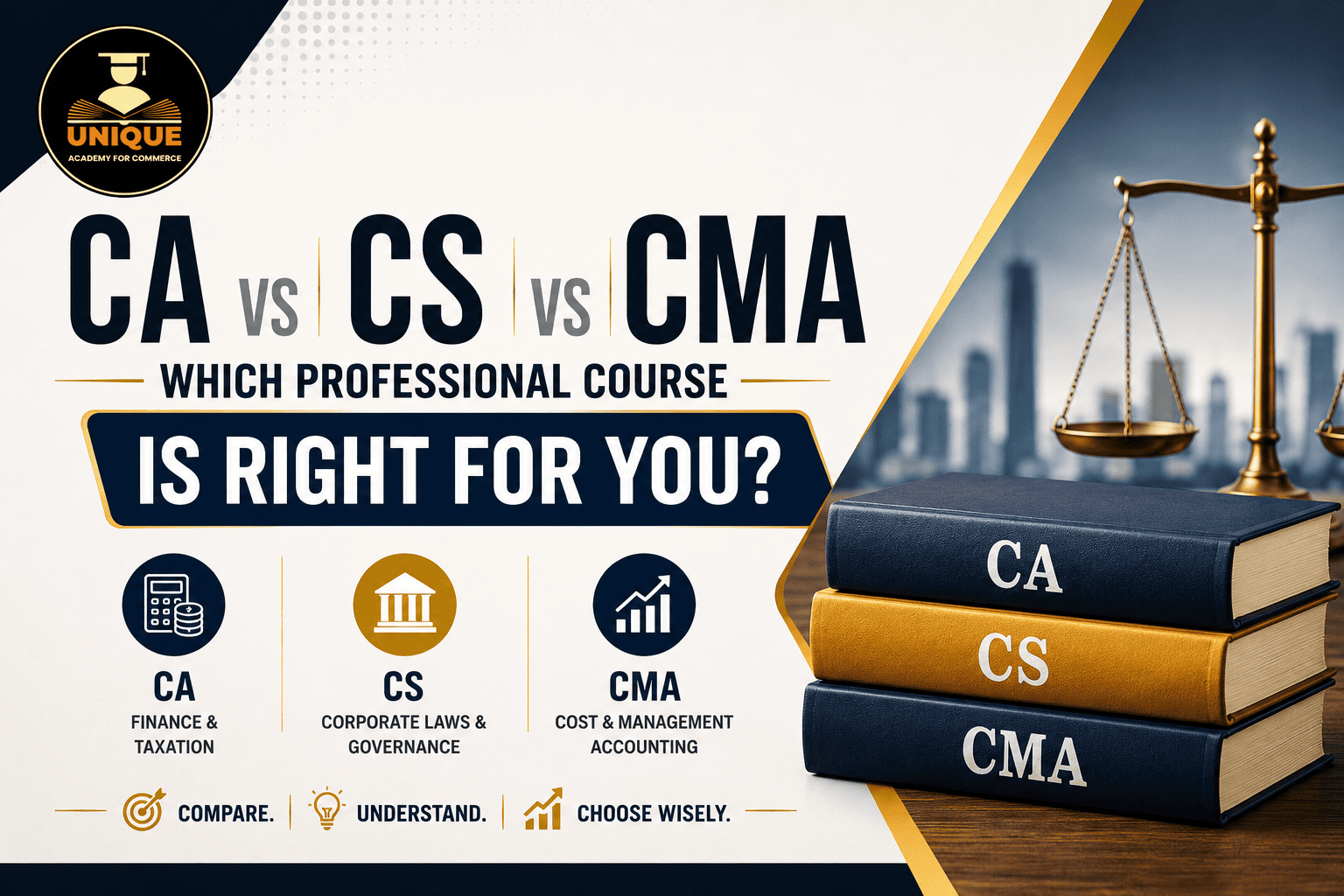
Choosing a professional course after class 12 or after completion of graduation is one of the major decisions for a commerce student. CA VS CS, VS CMA are three of the most respectable and profitable professional courses in India. Though all these professional courses lead to very fruitful careers, the type of work, skills required, pattern of study, and career options differ a lot.
If you are confused about which professional course to opt for, then this elaborate comparison of CA vs CS vs CMA would help you out and take a decision for yourself.
An Overview of CA, CS, and CMA
Before going through any comparative analysis of the professional courses, it is essential to know about the basics of the respective course.
CA – Chartered Accountancy mainly covers topics related to accounting, auditing, taxation, and financial management. A CA professional works for proper financial reporting, taxation, and compliances.
Company Secretary – The curriculum revolves around corporate laws, governance, compliances, and secretarial activities. Company Secretary works as an intermediary between company, directors, regulators, and all other stakeholders.
CMA – Cost and Management Accountant: Cost Accounting, Financial, budgeting, performance management, strategic decision-making.
What is the Structure and Duration of Courses?
These are all three professional courses which are provided by the respective governing statutory bodies in India.
CA is regulated by the Institute of Chartered Accountants of India (ICAI). CA Curriculum includes Foundation, Intermediate, Final and Articleship level. It generally takes 5 years to complete.
This CS course is regulated by the Institute of Company Secretaries of India (ICSI). The course structure consists of CSEET (entry test), Executive, and Professional levels with practical sessions. The course duration varies between 3 to 4 years.
CMA is regulated by the Institute of Cost Accountants of India (ICMAI).
There are levels in CMA such as Foundation, Intermediate, and Final, which have practical training sessions. It would take a person about 3.5 to 4 years to complete the CMA course.
What is the Difficulty Level For the courses CA vs CS vs CMA?
CA has been regarded as the most difficult among the three. The subjects that the CA course includes accounting standards, auditing, direct and indirect taxes, financial laws, and so on. The pass percentage of this course is quite low.
CS is theory based course, those individuals who enjoy reading and understanding laws and interpretation of cases find CS to be their niche.
CMA course is numbers based. The topic areas covered in this course include costing, management accounting, financial analysis, and decision making. A candidate with analytical abilities is likely to go for CMA course.
What are the Skills Required for Each Course?
A set of particular skills is needed for each professional course.
For CA, a candidate needs to have analytical skills, mathematical skills, patience and discipline.
For CS, it becomes imperative to have an understanding of corporate laws, communication skills, attention to detail, and a systematic way to learn theoretical concepts.
In case of CMA, the important skills include logical reasoning, numeric ability and decoding of financial statements.
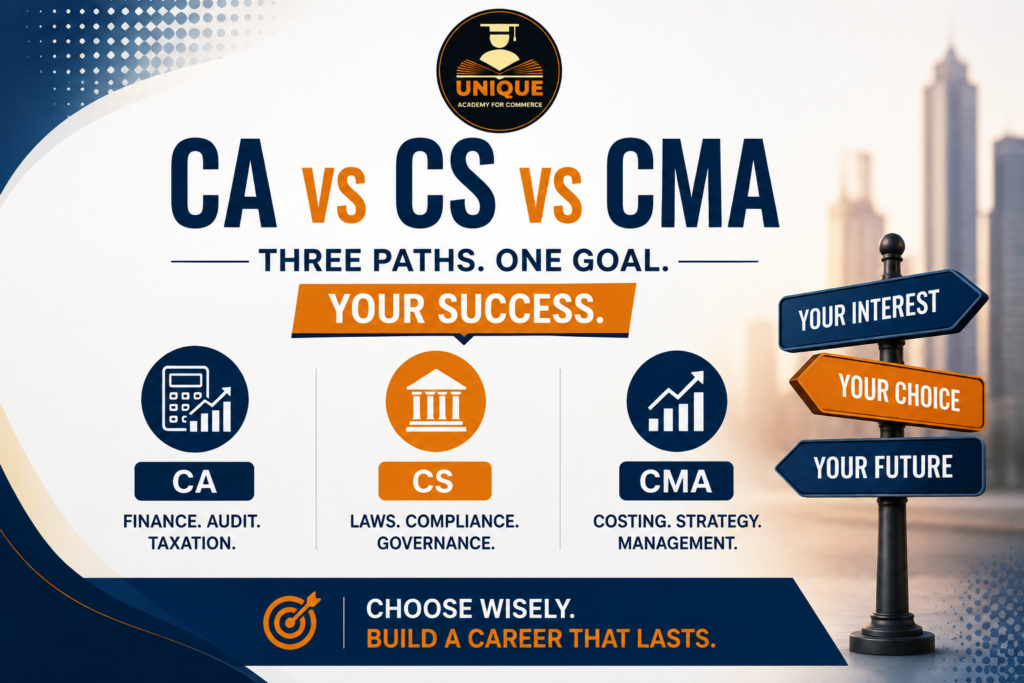
What are the Professional Opportunities and Jobs available?
The job opportunities available to CA, CS and CMA are very different.
Every Chartered Accountant has a choice to be an auditor, tax consultant, financial analyst, CFO or enter into practice. There is tremendous demand for CAs in all sectors, accounting firms, banks and consulting companies.
Company Secretary works in corporate offices dealing with compliance, corporate governance, board meetings, mergers, filing of regulations and other tasks. CS professionals also occupy key positions in legal, compliance and advisory departments.
Cost and Management Accountant would work in manufacturing, FMCG, IT and service industries.
Career Options
Common careers include cost controller, financial planner, business analyst, internal auditor, and strategy consultant.
Salary and Growth Potential
However, all the above courses have a high pay scale in the early stages of their careers.
On average, a fresh CA gets an annual package of ₹8–12 lakhs and the same rises quite quickly with experience.
The salary for a fresh CS member is expected to be ₹5–8 lakhs annually, especially in listed companies and big corporations.
Similarly, a fresh CMA earns a salary of ₹5–8 lakhs annually, mostly in the highly cost-intensive industries.
Thus, it is obvious that long-term growth mostly depends upon the skills, experience, and exposure to different industries rather than the qualification.
Which course is best for whom?
The best course for those students having an inclination towards accounting, taxation, and finance and ready to take up a difficult academic course is that of CA.
Go for CS course if you are interested in corporate laws, corporate governance, as well as laws related to legal compliance in the company. You will like to study in this field
Select CMA if you are interested in cost management, strategic planning, and performance analysis.
A lot of these people opt for CA with CMA or CS with CMA as the double certification courses in order to increase employment opportunities.
In short
Actually, there is no such thing called the best course between CA, CS, and CMA because all the three courses have their own respect, security, and opportunities of growth.
Knowing the differences between CA, CS, and CMA will help you to select the stream of job opportunities which can not only provide you with the money, but also motivate you at the same time.
Frequently Asked Questions (FAQ’S)
On average, Chartered Accountants tend to receive the highest starting salary. However, experienced CS and CMA professionals also earn excellent compensation depending on their role and industry.
Yes nowadays it is often seen that candidates do regular college with CA CS CMA courses to stay ahead of the competition, managing all at a time.
All three are equally good. You must make a choice based on your interest—finance related (CA), corporate law related (CS), or costing/management related (CMA).
Yes, students of science, arts, and commerce streams can all do CA, CS, and CMA. Though mathematics is not required, having grip in figures is important especially in CA.