Blog
ICSI CSEET Study Material: 10 Smart Ways to Use It Effectively

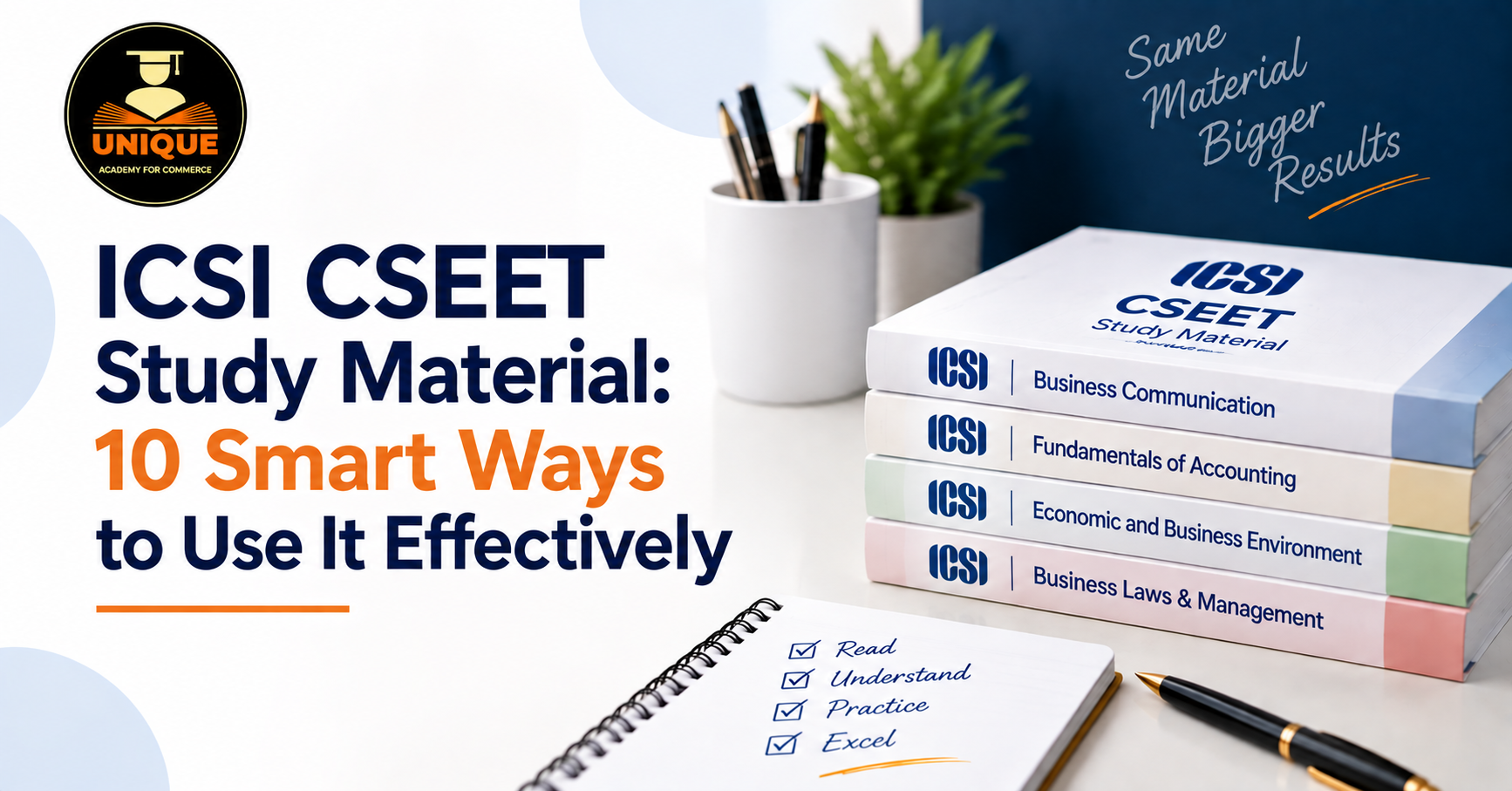
Every CSEET student gets the official study material from ICSI, yet not all of them use it to the fullest. Some treat it as a book to glance through once and others use third party coaching materials instead and refer to the books only occasionally.
However, none of these strategies makes any sense because ICSI’s study material is designed according to the exam pattern, syllabus weightage and types of questions you’ll encounter.
Here is how to extract maximum value out of official study material to have structured preparation.
1. Read the Syllabus First before You Start any Chapter
Before you dive into reading study material, you should take time to study the syllabus document separately. Knowing how marks distribution will work across topics can help in prioritizing effort instead of putting equal amount of work on all the chapters. After getting familiar with the bigger picture, individual chapters will become more understandable within each paper context.
2. Do Not Read Passively
A common mistake committed by CSEET students is reading chapters cover-to-cover without any engagement with the material. The practice of reading passively may seem effective at the point of time but retention is low unless there is an element of involvement.
3. Take the Illustrations and Solved Examples Seriously
In the study material provided by ICSI, there will be solved examples at the end of every chapter and students tend to skip them. However, it would be helpful if the candidate tries to solve the question and compares their own answer with the solution given.
4. Divide the Chapters into Sections
Some chapters can be lengthy, especially in subjects such as Business Communication and Economic and Business Environment, and dividing these chapters into sections would be easier for preparation.
5. Check for the Latest Amendments and Updates
Since ICSI keeps updating the syllabus and study material based on the pattern and regulation changes, there might be gaps while studying from old editions of the book. So, before getting into preparing, it would be wise to go through the official website and check if the study material is latest and updated.
Visit Unique Adacemy For Commerce for more CSEET Related Updated
6. Highlight Selectively, Not Too Much
Highlighting is a good strategy but many students tend to highlight almost every alternate line. In doing so, it becomes useless, a more sensible way would be to highlight only the most essential definitions, formulas or exam-relevant information, so that a quick revision in the last days before the exam immediately grabs your attention to the most important parts of the material.
7. Combine Study Material With Mock Tests Regularly
While reading of the official material makes you knowledgeable, solving problems in the conditions of the exam makes you exam-ready. Having studied a particular chapter or section, one can try solving some related questions in the mock tests or sample papers to consolidate the information received.
8. Go Over the Difficult Topics Rather Than Ignore Them
It is quite natural to prefer reading the chapters that seem to be comfortable, leaving the difficult topics till the last moment. This tendency often turns into a problem before the exam when there is not much time left for revising the weak spots. In order to avoid the rush, one needs to schedule revision of difficult sections, including those that have not been completely understood yet.
9. Use the Material Alongside Official Sample Papers
Usually, ICSI provides separate sample papers apart from the study material. The use of both material and sample papers makes a complete preparation process. The former builds up the conceptual understanding while the latter helps in testing it in exam form. Completing chapters related to sample questions and then solving them can help in receiving feedback at every stage of preparation.
10. Revision Using Personal Notes Instead of the Book
As the examination nears, re-reading of whole chapters becomes impractical. In this phase, personal notes, prepared during the first round of reading of the study material (assuming you have prepared them in a thoughtful manner) become the main tool. Self-written condensed notes are quicker to revise and recollect than the paragraphs from the book. You will have to refer to the original study material only if some particular concepts seem confusing or vague.
Conclusion
The official study material provided by ICSI is the most reliable material for preparing for the CSEET exam due to its direct alignment with the syllabus and exam pattern. But merely having this material will not be enough. What matters is how you use it!
Frequently Asked Questions
Many students do not require any coaching as they have sufficient knowledge through study material along with self-practice and mock tests.
However, there are a few students who require coaching due to lack of a structured approach or clarity on certain doubts in the topics covered under study material, especially those which they find difficult.
ICSI changes the study material whenever there is any change in the syllabus or pattern of the examination or relevant rules and regulations. There is no fixed time frame for changing the study material.
Hence, while starting preparation, it is better to check the official website of ICSI to ensure that one is following the updated version. At times, supplementary notifications may be issued separately.
It is always better to prepare notes for all the chapters even those which we find easy as at the time of exam, one might forget the chapters if proper notes have not been made. Nevertheless, challenging sections may require extensive notes as opposed to easy ones, where summary notes will do just fine.
The bottom line here is consistency so as not to make revisions rely on having to go back and reread the whole textbook.
It would be wise to integrate sample papers slowly after each chapter or part that one has finished, as opposed to doing so at the very end of the study process.
This way, one receives continuous feedback on whether he/she has understood the material and how well the concept is learned.
It is more efficient to read all the material only once provided there are well-written notes taken, as opposed to multiple readings of the material as a whole.
Multiple readings can be inefficient without yielding any results because of lack of previous activity in studying the material.