Blog
CSEET New Syllabus 2026: Full Pattern, Subjects & Changes

What is CSEET?
CSEET — the Company Secretary Executive Entrance Test — is the gateway exam ICSI uses to admit students into the CS Executive Programme. Clear it, and you’re eligible to register for Executive. It’s meant to check whether you’ve got the basic aptitude — communication, numbers, business sense, legal reasoning — to handle a professional course that gets progressively harder.
What’s actually new about CSEET in 2026?
Is this really a different exam now, or just a few tweaks?
It’s a complete change . The older CSEET was a single-day, remote-proctored, all-MCQ test. The 2026 version spreads across four days, moves to offline mode at test centres, and swaps most of the pure-MCQ format for subjective, write-your-own-answer papers. That’s a meaningfully different skill set to prepare for.
How often is CSEET conducted now?
Three times a year instead of the earlier cycle — sessions in February, June, and October. That gives students more entry points, which is genuinely useful if you miss one cycle for any reason.
When did this new pattern kick in?
June 2026 was the first session run entirely under the restructured format, held over four days from June 1 to June 4. Every session from that point forward — including October 2026 — follows this same structure.
Why did ICSI bother changing it at all?
The stated reasoning is to test genuine conceptual understanding rather than rote memorisation and quick guessing, which is a fair criticism of the old rapid-fire MCQ style. A four-day, mostly-subjective format forces you to actually explain what you know instead of eliminating wrong options.
What are the CSEET subjects now?
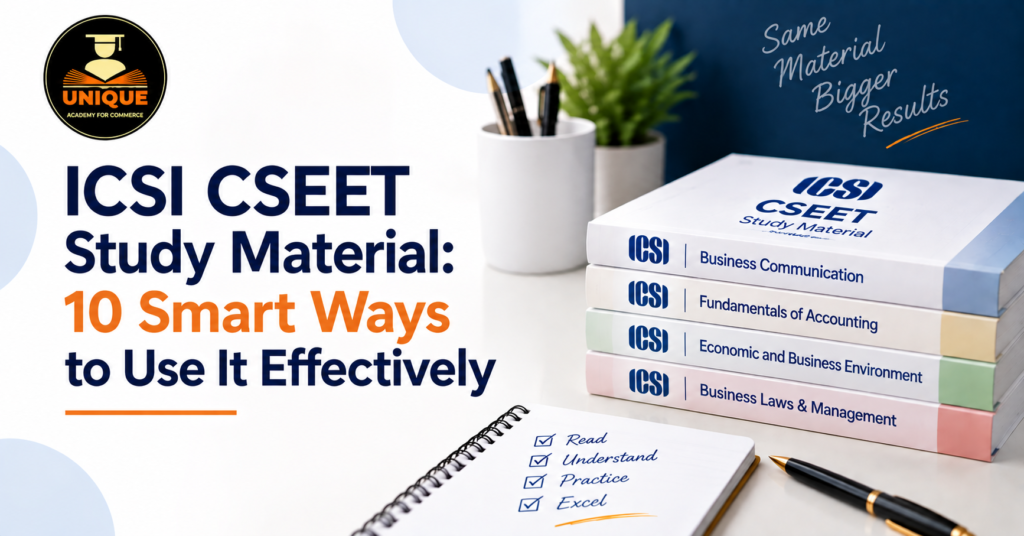
There are still four papers, but a couple of them have been renamed and restructured internally:
- Business Communication
- Fundamentals of Accounting
- Economic and Business Environment
- Business Laws and Management
Each paper carries 100 marks, taking the total to 400 — a notable jump from the earlier 200-mark structure, which alone tells you the depth of assessment has increased.
What does each paper actually cover?
What’s in Business Communication?
The essentials of clear written and spoken English, business correspondence formats (emails, letters, memos — the stuff you’ll actually draft as a CS), and common business terminology you’re expected to know cold.
What about Fundamentals of Accounting?
This one’s fairly comprehensive — basic accounting principles and processes, bank reconciliation statements, depreciation and amortisation, preparing final accounts for sole proprietorships, partnership and LLP accounts, a light introduction to company accounts, and accounting for non-profit organisations. If you’ve never touched accounting before, this is the paper that needs the earliest start.
How is Economic and Business Environment split?
Two halves, 50 marks each. Part A is economics — demand and supply basics, market competition structures, national income accounting, the Union Budget, Indian financial markets, and the broader Indian economy. Part B moves into business environment territory — entrepreneurship, key government institutions, global business environment, environmental governance, corporate governance basics, and — a genuinely new addition — how AI is reshaping the business landscape.
And Business Laws and Management?
Also split into two parts. Business Laws (60 marks) covers introductory legal concepts, elements of company law, the law of contracts, and partnership/LLP law. Business Management (40 marks) covers management fundamentals, functions of management, key management principles and modern approaches, and management knowledge specifically relevant to a company secretary’s role.
Visit this link for free CSEET classes
What does the actual exam day structure look like?
How many days does the exam run over?
Four separate days, with one paper sat on each day rather than the older single-sitting format.
Is each paper timed the same way?
Not quite. Three of the four papers — Business Communication, Fundamentals of Accounting, and Economic and Business Environment — are subjective, written answers, each given three hours. Business Laws and Management, on the other hand, is OMR-based (essentially a structured objective-response format) and runs for two hours.
Is there negative marking?
This is one area where sources genuinely differ, so treat it as unconfirmed until you check the latest ICSI circular directly — some official-facing summaries describe a no-penalty approach for objective sections, while others reference negative marking for incorrect responses. Don’t build your exam-day strategy around an assumption here; verify it on icsi.edu closer to your session.
What’s this viva voce component I keep hearing about?
A 15-minute oral component worth 30 marks, designed specifically to assess your presentation and communication skills — the kind of soft skill that matters enormously in an actual CS career. It’s conducted at authorised test centres, sometimes through AI-assisted or pre-recorded formats depending on the session.

How should you actually prepare for this?
A few honest observations, not the usual generic “study hard” advice:
- Play to your strength first, then attack your weak paper early. If accounting terrifies you and communication feels natural, don’t leave accounting for the final month — start there.
- Practice writing, not just recognising. Since three papers are now subjective, the skill of clearly structuring a written answer under time pressure matters as much as knowing the content.
- Stay current with business news. The Economic and Business Environment paper leans heavily on real-world awareness — Union Budget details, financial market movements, current government schemes — so a habit of reading business news pays off more than last-minute cramming.
- Don’t skip the viva voce prep. It’s easy to treat 30 marks as an afterthought next to four 100-mark papers, but it’s still meaningful weight, and it’s the one component that rewards simply practising speaking clearly out loud.
- Use ICSI’s own study material as your base, and treat third-party guides (including this one) as supplementary — syllabus details get revised, and the official PDF is always the final word.
FAQs
Four – Business Communication, Fundamentals of Accounting, Economic and Business Environment, and Business Laws and Management.
Total of 400 marks, with each of the four papers carrying 100 marks, apart from 15 minutes’ viva voce that carries 30 marks in Paper 4.
No. With the new pattern, the examination is conducted over four different days, with one paper conducted on each day.
Offline, through the test centres – compared to online remote-proctored examination earlier.
Three sessions, which are conducted in February, June, and October.