Blog
How to Prepare CSEET Fundamentals of Accounting from Zero?

For many candidates of CSEET, the words “debit,” “credit,” and “trial balance” may mean nothing right at the outset of their preparation. It’s not a problem though. Fundamentals of Accounting is a recently introduced subjective paper of 100 marks under the restructured CSEET, and a large number of candidates writing this paper are from non-commerce background and have no prior experience of accounting education.
I don’t have of accounting background. Does it make me ineligible for passing this paper?
No, it doesn’t, and that too should be made clear upfront. Fundamentals of Accounting has been introduced because ICSI expects its candidates to have no accounting background, and that’s how the whole syllabus has been designed. Candidates following the syllabus sequentially will find it quite easy.
What does this paper contain?
The paper covers all the topics in the accounting cycle: the meaning and nature of accounting, double entry system, debit and credit rules, journal entries, subsidiary books and cash books, ledger posting, preparation of trial balance, rectification of errors and depreciation including straight-line method and diminishing-balance method
The rules of debit and credit appear quite confusing. How should I tackle it?
Instead of memorizing debit and credit as a rule, it would be better to learn it through accounts. Assets and expenses increase through debit, whereas liability, income, and capital increase through credit. As soon as you classify each account in one of the five above heads, most often, application of debit and credit will become automatic.
Visit Unique Academy For Commerce for more CS Foundation Updates
In what order should I study the topics?
As accounting cycle follows a natural order, it’s better to stick to it while studying the topics as follows:
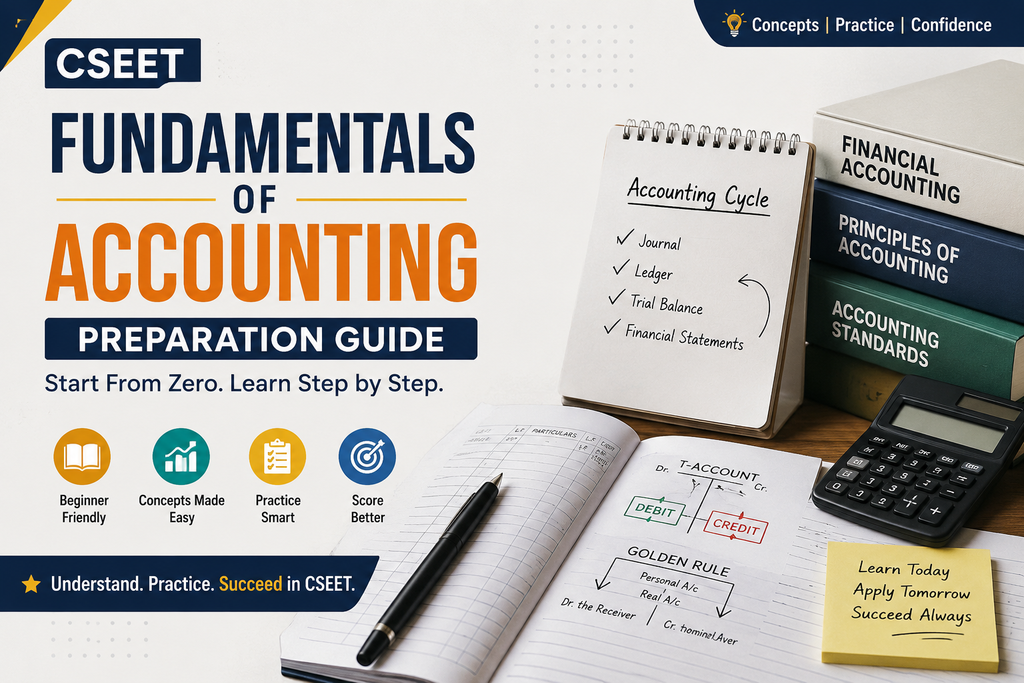
1. Basic concepts and meaning of accounting
2. Double entry system and debit and credit rules
3. Journal entries
4. Subsidiary books and cash books
5. Ledger posting
6. Trial balance
7. Rectification of errors
8. Depreciation
How much time should a genuine beginner devote to Fundamentals of Accounting subject?
This subject deserves more time initially than most of the other subjects in CSEET. Unlike most other subjects, accounting requires a lot of practice to master and not just reading. So in the first few weeks, you should spend two hours per day: one hour for learning a new concept and the other hour for solving.
I get to understand a concept by reading but cannot solve it independently. What does it mean?
This is the normal phase where one gets the theoretical concept but not the underlying pattern. It does not require more reading but rather more exposure to solved examples coupled with independent attempts of similar problems.
How can one verify if the topic is really understood and not just memorized?
One way of doing this is to solve a new question without any help from the notes. One can test him/herself on the journalizing of a transaction, posting it in the correct ledgers and then preparing a tallying trial balance without referring to previous questions. This way the topic is understood and not memorized. Else, one has to try again on similar questions.
How should one write answers in the test?
The whole method should be shown instead of the answer only. In fact, the accounting answers will be evaluated mainly on the basis of the method. One who has correct journal entries and posting to the ledgers will be able to score most of the marks even if the trial balance does not tally. All workings should be labeled in an easy-to-read manner – for example, “Journal Entry,” “Ledger Posting,” and “Trial Balance,” etc.
What should be done during the last two weeks before the test?
One should focus from studying the new topics to practicing the complete questions and past-pattern questions in the allocated time. The topics which were toughest for him/her — usually rectification of errors and depreciation — need to be revised one more time from scratch.
FAQ
Yes. It is a newly introduced paper in the revamped CSEET paper and does not assume any prior knowledge of accounting or commerce.
The paper has 100 marks with a duration of three hours, to be conducted on the second day of the four days’ CSEET examination cycle.
Some of the important subjects in this paper include the concept of accounting, double entry system, rules of debit and credit, journal entries, subsidiary books and cash book, ledger, trial balance, correction of errors and depreciation, straight line and diminishing balance method, resulting in financial statements understanding.
With regular study of about forty-five to ninety minutes every day including study of concepts as well as solving the problems based thereon, even beginners can develop good understanding of the core subjects in four to six weeks, if the fundamentals are not missed out on.
It is better to understand the underlying logic. In most cases the formulas which have been memorized without understanding their logic fail if the question is phrased in different manner. Once the underlying logic is understood, the use of formulas like that of depreciation becomes easy.
Yes. In accounting, it is the method and the workings that fetch more marks than just the final figure; so the process being correct but the final figure being wrong will fetch you considerable mark. Hence it is advised to show all the workings in your answer.