Blog
CMA Intermediate Exemption: 60% Rule, Eligibility & Process

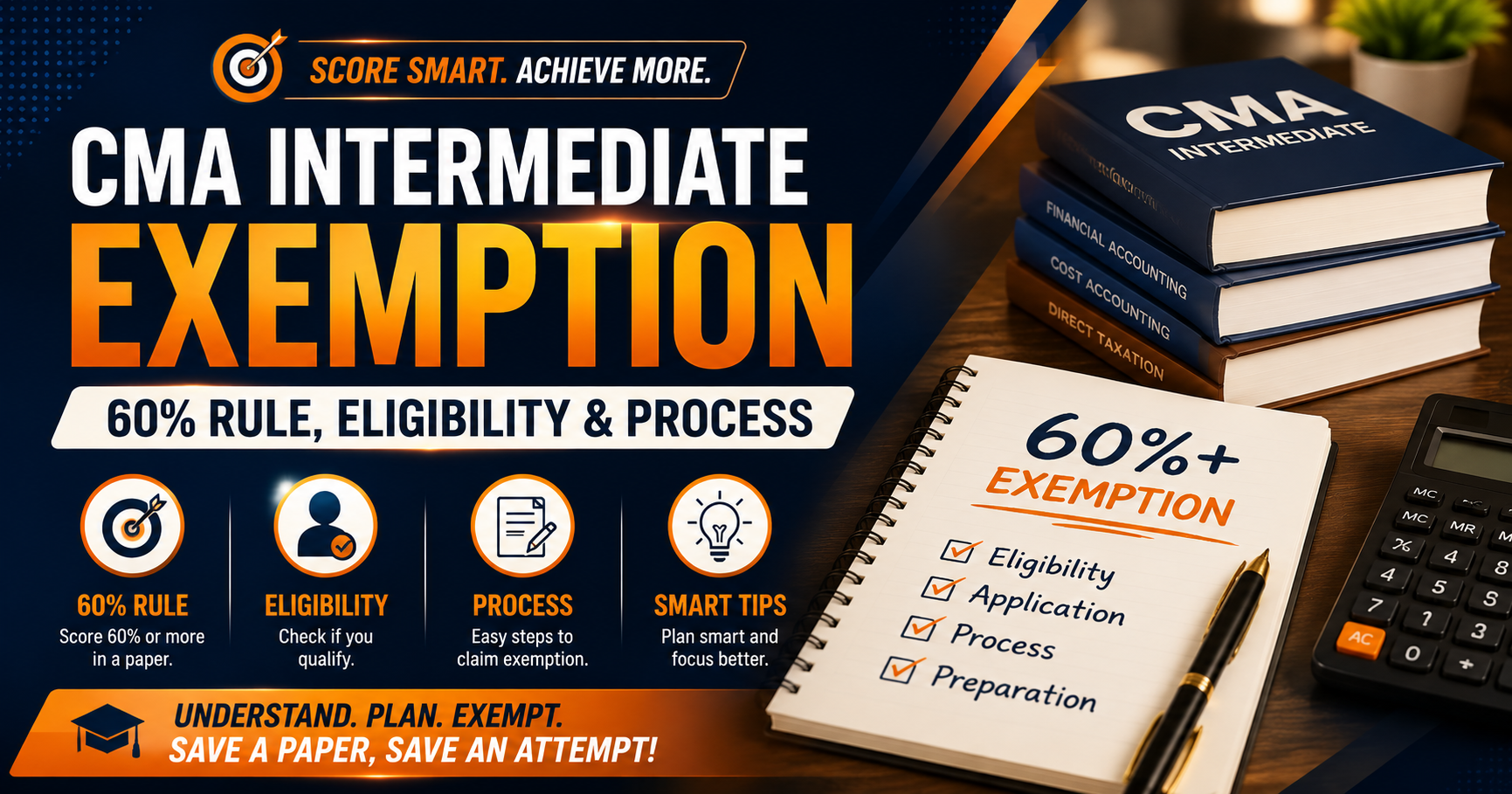
The Cost and Management Accountancy (CMA) qualification by ICMAI is a very prestigious degree in Finance. The Intermediate level is the second rung of this three-tier ladder, and it is not a cakewalk. Eight papers spread across two groups, each demanding solid conceptual clarity and calculation speed — it’s a genuine test of endurance. Getting to know and understand the CMA Intermediate Exemption rules can help students plan their next attempt and focus more on their studies to clear the remaining subjects.
But here’s the silver lining: ICMAI’s exemption policy means that if you’ve already cleared certain subjects or scored impressively in them, you might not have to repeat the effort. This guide walks you through everything — who qualifies, how to apply, which papers get covered, and smart strategies to make the most of your exemption window.
What is an exemption in CMA Intermediate?
In simple terms, an exemption means ICMAI “excuses” you from appearing in one or more papers in a future attempt. You are treated as having already cleared that paper, so your overall result is calculated without it pulling you down.
There is a score-based CMA Intermediate exemption criteria you should know about: score-based exemption-where you score above a threshold in a paper even if you fail the group overall.
Who qualifies?
The core eligibility criteria
Score-based (60% rule)
Score 60% or more in an individual paper while failing the group as a whole — that paper is exempt in the next two attempts.
Important note
Exemption rules are updated periodically by ICMAI. Always cross-check with the official ICMAI website or your registered study centre before applying. The details here reflect the general framework as of the most recent syllabus revision.
Score-based exemption — how the 60% threshold works
This is the most common type of exemption students encounter. Say you’re attempting Group I (Papers 5–8) and you score 72 in Paper 5 but fail the group because your aggregate isn’t good enough. That 72 doesn’t disappear — ICMAI records it and grants you an exemption for Paper 5 in your next two consecutive attempts.
This is genuinely valuable. Instead of revising a subject you’ve already mastered at near-distinction level, you can redirect that time to the papers that actually brought your average down.
Practical tip: Even if you are confident about clearing a group in one shot, aim for 60+ in every paper individually.
Step-by-step: how to apply for an exemption
- Check your marksheet carefully After results are declared, review your individual paper marks. If any paper shows 60 or above and the group result is “fail,” that paper is eligible.
- Login to ICMAI Student Portal Login to www.icmai.in student portal using your registration number. Go to Examination tab.
- Fill the Exemptions Form Select the papers for which you wish to apply for exemption. If the exemptions are being taken on qualification basis, you have to upload the related documents (degree certificate, CA/CS passing certificate etc).
- Payment of relevant fee A small exemption fee is required for each paper. It is different from your examination registration fee.
- Submit your application on time Your exemption request must be submitted within the stipulated period for examination registration of next attempt. No requests received after deadline are entertained.
- Verify that the admit card indicates your exemption Once the exemption request is approved, make sure that your admit card shows it.
What should be your preparation strategy to score 60% in every paper?
Exemption cannot happen by chance; it needs proper planning. Here’s how to prepare yourself so that the exemption comes to you automatically.
Step 1: Identify your strong subjects early. If you’re naturally comfortable with Financial Accounting or Direct Taxation, double down on those rather than spreading effort uniformly. A 70+ in a strong subject is far more valuable than a 45 across the board.
Step 2: past exam papers are your best friend. ICMAI’s question patterns are fairly consistent, and most 60%+ scores come from candidates who have solved at least five years of previous papers in full, under timed conditions. This is not optional; it is the minimum baseline.
Step 3: practice calculation-heavy papers (Cost Accounting, Financial Management) daily. Accuracy and speed in these papers deteriorate quickly without daily practice. Even 30 minutes of focused problem-solving every day can make the difference between 55 and 65 in these papers.
Study tip: Attempt mock tests in exam-hall conditions — no phone, no music, strict time limits. Self-assessed mocks consistently predict actual exam performance within 5–8 marks.
What happens to your CMA Intermediate exemption if you don’t use it?
This is a question many students ask and then regret not asking earlier. A score-based exemption is valid for two consecutive attempts following the one in which it was earned. If you skip one attempt (say you take a break for a semester), that still counts as one of your two attempts. The exemption does not pause.
Additionally, if you clear the full group in a later attempt without using the exemption, it simply lapses — there’s no carryover to the Final level. Exemptions are Intermediate-specific.
Common mistakes students make with CMA Intermediate exemptions
One of the most frequent errors is forgetting to formally claim the exemption. The 60% score alone does not activate the exemption automatically in every scenario — you often need to apply for it explicitly during the registration window. Missing that window means sitting through a paper you didn’t need to write.
Another mistake is over-relying on exemptions and under-preparing for the remaining papers. Having two or three papers exempted can create a false sense of security. The papers you still need to clear deserve full preparation cycles, not reduced effort.
Finally, some students claim qualification-based exemptions without verifying the current ICMAI equivalency list. Syllabi evolve, and a paper that was exempt under an older agreement may no longer qualify.
Frequently Asked Questions
No. Score-based exemptions only apply when the group result is a failure overall. If you passed the group, there’s nothing to exempt — you’ve already cleared it.
A score-based exemption (60% in an individual paper) is valid for two consecutive attempts after the one in which the score was earned. If you do not use it within those two attempts, it lapses regardless of whether you actually sat for the exam.
No. Exemptions granted at the Intermediate level are only for inter. Once you move to the CMA Final, you start fresh with no carry-over exemptions from Intermediate results.