Blog
CS Foundation Syllabus 2027: Subject-Wise Syllabus & PDF

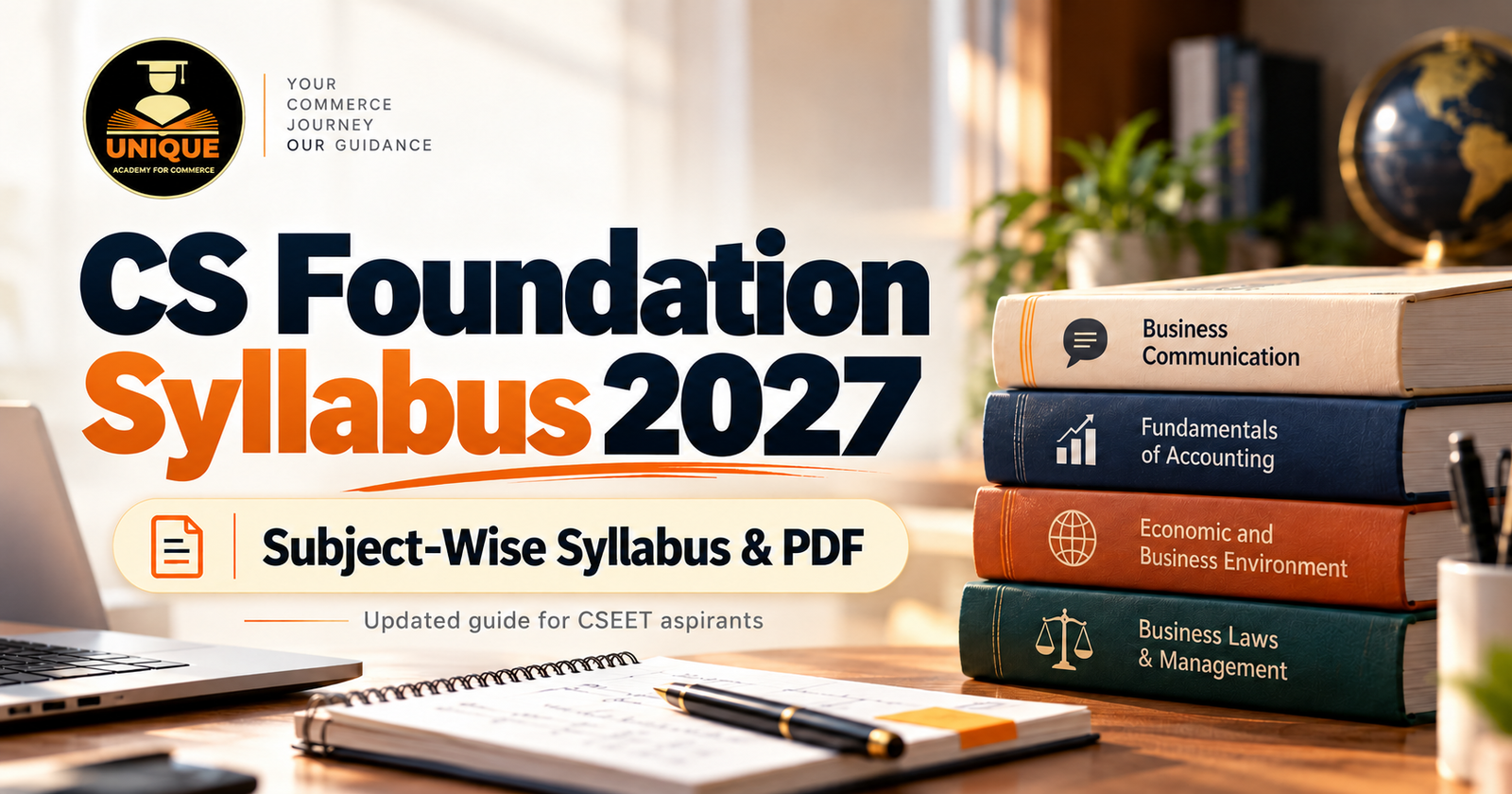
Students beginning their journey toward becoming a Company Secretary often start by searching for the CS Foundation Syllabus 2027 to understand the subjects and exam structure. Officially, the current entry-level exam is CSEET, and its syllabus was significantly restructured by ICSI for the 2026 sessions.
The revised pattern replaced the earlier one-day objective test with a subject-wise exam format spread across separate days, requiring deeper understanding and stronger written preparation. In this blog, we break down the CS Foundation Syllabus 2027 paper by paper, covering the major topics, marks distribution, and areas that may require extra practice.
What Makes the CS Foundation Syllabus 2027 Different?
Previous versions of this entrance exam were mostly based on multiple choice questions which had to be answered within 2-3 hours of time. The newly introduced format, to be used starting from June 2026, implies spread of the entire exam process across 4 consecutive days, including 3 subjective papers in a descriptive pattern.
Such change is very important for the preparation process. In the previous case candidates just had to choose a right answer, but now they have to write the answer themselves.
Consequently, students enrolling in the CS course from 2026 will require practical knowledge of writing along with theoretical knowledge and not just memorisation.
Each paper comprises 100 marks, thereby making a total of 400 marks for the complete examination.
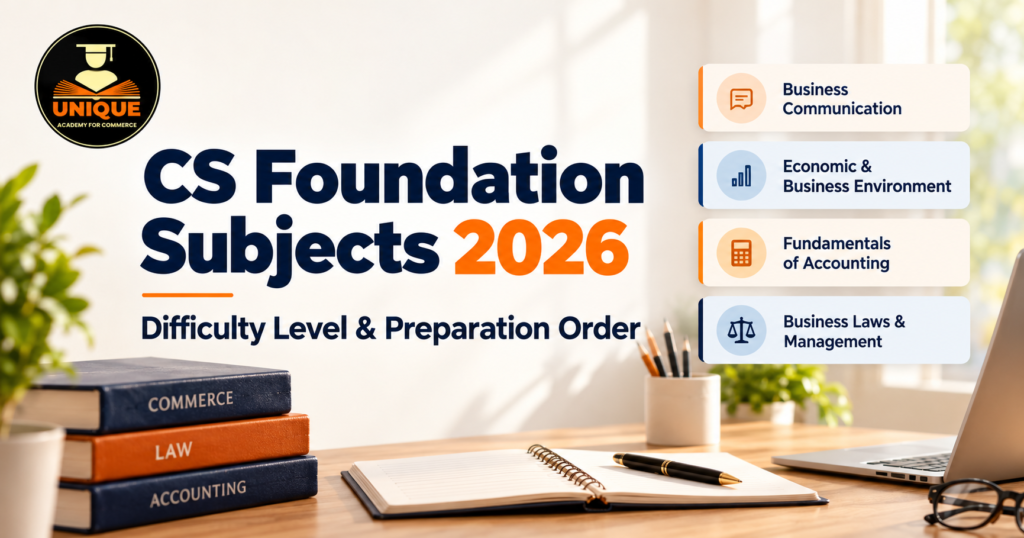
CS Foundation Syllabus 2027: Subject-Wise Overview
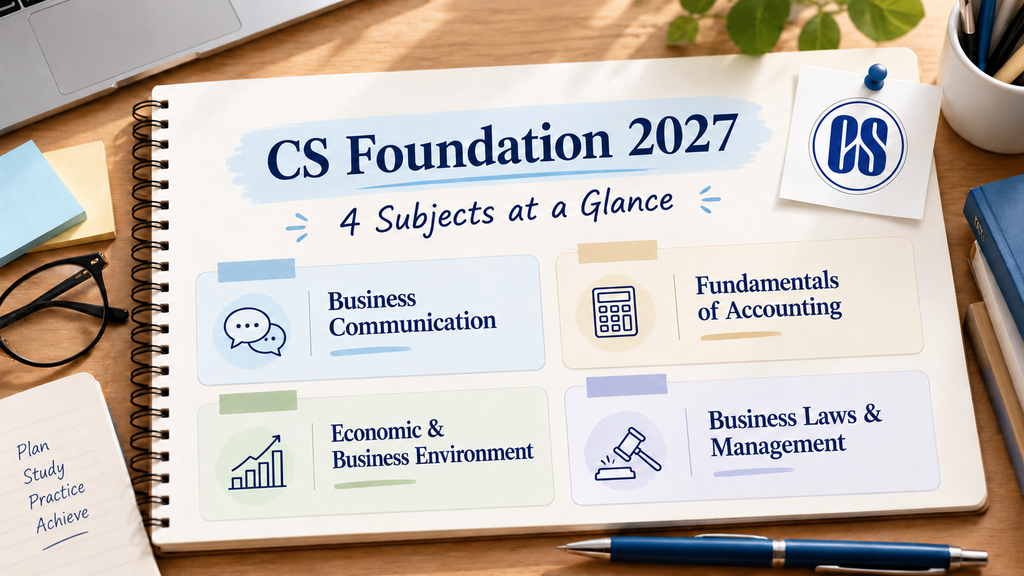
| Paper | Subjects – CS foundation |
| 1 | Business Communication |
| 2 | Fundamentals of Accounting |
| 3 | Economic and Business Environment Part A: Economics (50 Marks) Part B: Business Environment (50 Marks) |
| 4 | Business Law and Management Part A: Business Laws (60 marks) Part B: Business Management (40 Marks) |
Paper 1: Business Communication
This subjective paper of 100 marks in three hours judges the effectiveness with which a candidate conveys his or her ideas in a professional business setting. The coverage commences with the basic concepts of communication, including grammar rules and vocabulary that is required for business writing.
Correspondence of a business kind constitutes a major part in this paper and covers professional letter writing, email writing and report writing. The reading comprehension tests the candidate’s proficiency in comprehending and summarising the passage while presentation skills test the ability of the candidate to present information in a structured manner.
A relatively recent addition to this paper is the responsible use of AI in business communication, as digital help is now a part of daily professional writing. Regular practice of writing in various formats is advisable to the candidates since the examiners always appreciate structure and clarity rather than long irrelevant answers.
Paper 2: Fundamentals of Accounting
This too is subjective and carries 100 marks. The coverage includes basics of accounting followed by the accounting process, which is done using journals and ledgers and preparing trial balances.
Depreciation and bank reconciliation statements are included in the syllabus, where numerical practice becomes more important than just memorizing theories.
Sole proprietorship, partnership, and LLP accounting form the bulk of this paper.
An introduction to company accounts gets the candidates ready for further coverage awaiting them at the executive level, while accounting of non-profit organisation completes the syllabus.
Another newly introduced subject in the digital age accounting completes the syllabus.
Visit Unique Academy For Commerce for more CS Foundation/CSEET Classes
Paper 3: Economic and Business Environment
This is also a subjective paper with equal marks allocated in both parts of 50 marks each. It begins with basic economic concepts and then moves towards the business environment.
Part A covers topics such as demand and supply concepts, different types of competition in the market, national income accounting, and Indian economic system.
Union Budget basics along with money markets and financial institutions are also covered in this part of the syllabus and will give candidates a practical understanding of how monetary policy works in the day to day economic activities.
Part B focuses on the specific business environment elements which include entrepreneurship, various types of business organizations, and the role of important government institutions. Some new additions to the course material include digital economy, digital public infrastructure and some important trends that affect the business environment in India, besides the factors that influence Indian businesses globally.
Paper 4: Business Laws and Management
Unlike Papers 1, 2 and 3, this particular paper involves objective testing done in 2 hours, with no negative marking involved. Yet, its scope of contents remains considerable, divided into legal and management parts.
The legal part involves the introduction to the business laws, legal terms and maxims followed by discussion about contracts, the Sale of Goods Act and negotiable instruments. The remaining legal part includes partnership law, Limited Liability Partnership provisions and the basics of company law.
The management part includes the basic knowledge about the theories of management and the 5 main functions of management which are planning, organizing, staffing, directing and controlling.
Since Paper 4 is the only paper in which the objective testing is used, solving varied multiple choice questions in it becomes particularly beneficial.
How Marks and Passing Criteria Work
In all four papers, candidates must have a minimum of 40% in each individual paper as well as an aggregate of 50%. The requirement of 40% in individual papers implies that it should be achieved in one attempt because there is no scope of carrying forward marks from previous sessions.
Also, there are no subject-wise exemptions in this structure. In such a scenario, preparing equally for all four subjects is mandatory. If one focuses on one paper at the cost of other papers and tries to compensate for the same, there is a great chance of failure.
Subject-Specific Exam Preparation Techniques
Due to the combination of subjective and objective formats in the same examination, it is important to divide your preparation methods accordingly.
Three papers out of four will require regular answering practice under time constraints. This helps the candidate develop both speed and clarity of structure in answering the questions.
While answering Business Laws and Management questions, solving topic-wise multiple-choice questions along with understanding the legal reasoning behind them helps prevent the pitfall of rote learning in the exam hall.
Alternating daily study periods of different subjects, instead of completing one paper first, is always beneficial for remaining balanced preparation.
Conclusion: Understanding the CS Foundation Syllabus 2026
The CS Foundation/CSEET syllabus for 2027 has become more demanding in comparison to the previous one since it includes various aspects of accounting, economics, law, and communication in its structure. Thus, the new test will provide a complete set of skills for those who wish to enter a professional program successfully. Knowing what is required from each paper helps in planning the preparation process more efficiently.
Establishing certain habits right at the start of your career is very beneficial since you will have them throughout the whole process.
FAQs
There are only three subjective papers in the CSEET syllabus: Business Communication, Fundamentals of Accounting, and Economic and Business Environment. One paper – Business Laws and Management – is not subjective and uses an OMR-based answer sheet. Preparation for the four papers should be therefore done accordingly.
No, there is no negative marking in any of the papers, even though one of them uses OMR-based answer sheets. That means that students can try answering every question without fearing the consequences. It is important to attempt all the questions to increase the chances of passing the exam.
The difficulty factor depends upon the candidate’s background, but in most cases, candidates lacking a background in commerce face some difficulties while solving the Fundamentals of Accounting as it is a numeric paper. Students of non-commerce background require additional time to prepare the journals and final accounts. However, with regular and daily preparation, this difficulty can be overcome easily.
No, because each paper separately carries a minimum of 40%. No matter how well you score in other papers, your aggregate score cannot help you in passing the paper scoring less than this percentage requirement. You have to clear all the papers to clear the exam and qualify for the executive level.
The paper alone is conducted through OMR objective questions rather than descriptive answering, and it takes only two hours of the examination time compared to the three hours taken in other papers. It covers both areas of business laws and management within a single paper.