Blog
Most Important Topics in CS Foundation Business Communication for February 2027

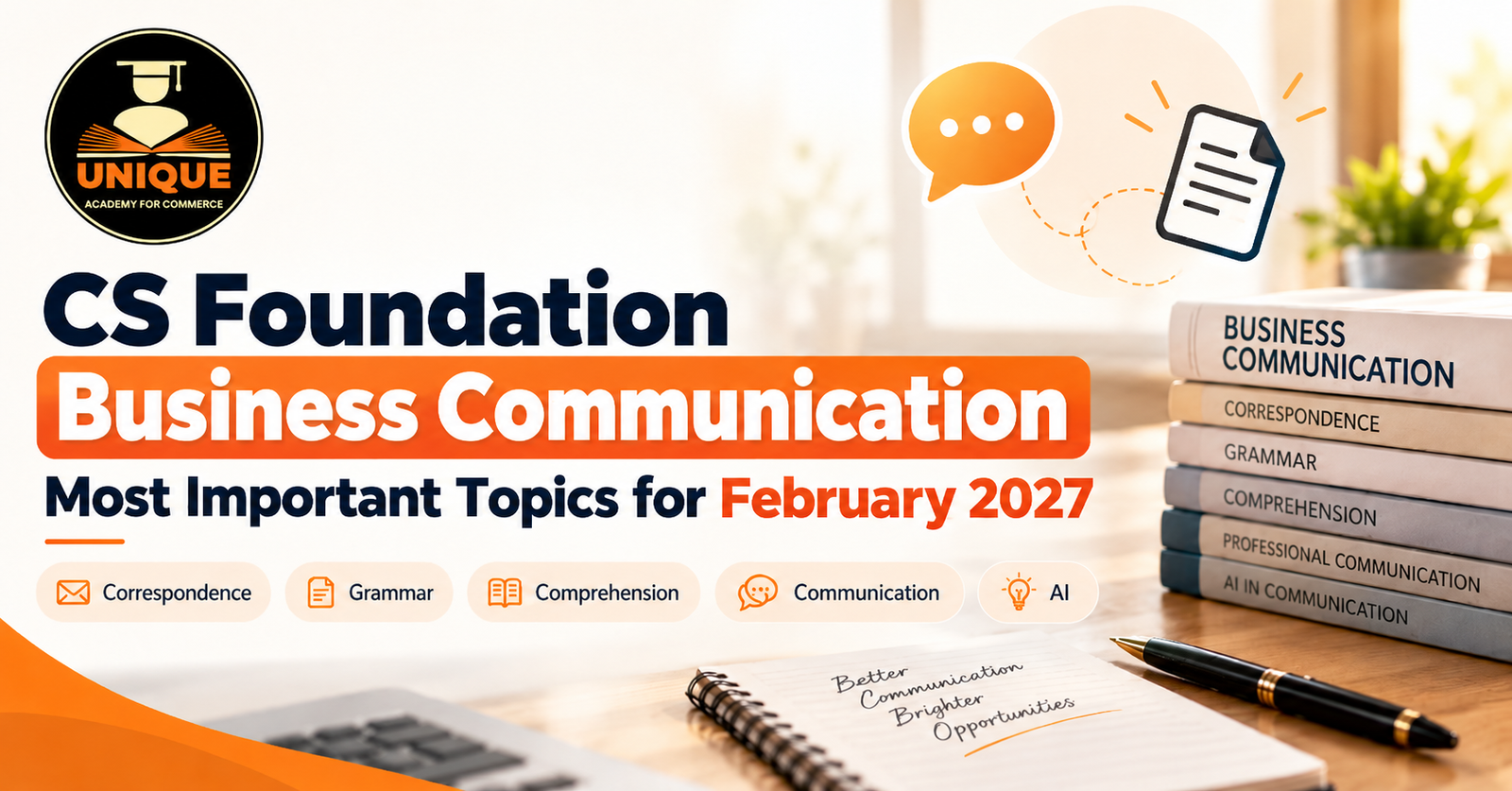
When you’re short on time before an exam, it naturally makes sense to wonder where to invest your energy first. Students preparing for the upcoming February 2027 CSEET session, still commonly searched online as “CS Foundation,” often look for the most important CS Foundation Communication Topics to prioritise during preparation.
Given the new pattern for this 100-mark, 3-hour subjective paper, spreading your effort too thinly across the syllabus can reduce the effectiveness of revision. This blog highlights the CS Foundation Communication Topics that deserve greater attention based on the syllabus structure and recent trends since the paper was restructured.
A Quick Disclaimer on the Nature of This blog
Let’s get something straight at the outset: ICSI doesn’t provide advanced topic weightages for a specific future session, and no official paper for February 2027 has been published yet. The following information is based on syllabus structure, recent patterns seen in June and October 2026, and the kind of topics that logically repeat, considering the nature of the subject.
Use it as a prioritisation guide rather than a prediction list, combining it with official material from ICSI for comprehensive coverage of the syllabus.
Correspondence Formats
Format-based questions have been consistently appearing in the subjective pattern for years now, and there is no reason for this trend to alter going forward either. Letters, memorandums, and business messages all have a specific format associated with them, and questions are designed to test the ability to draft them in addition to the theoretical knowledge of why the format is needed.
Considering the weightage drafting carries in one single question, mastering the entire format, right from addressing to closing remarks, becomes one of the most worthwhile tasks to dedicate time towards. Practising these formats rather than studying them is key, because recall under exam conditions differs from recognition while going through notes significantly.
Concept and Process of Communication
Basic theory regarding the meaning of communication, the significance of communication in the context of business, and the process of how communication occurs from sender to receiver remains relevant in this paper in some form. Questions are usually based on a brief scenario, poorly worded message or a lack of understanding and ask the candidate to find out what went wrong.
One of the elements of communication process – feedback – is of particular significance, as many questions related to communication barriers involve feedback and whether or not it was there and taken into account. Understanding the meaning of the term, rather than just memorizing it, becomes quite helpful in answering scenario-based questions formulated in a different way.
Modes and Networks of Communication
Different modes of communication, including written, oral, visual, and audiovisual, have their advantages, depending on the circumstances. Examiners often ask students to give justifications for choosing the particular mode for the described business situation. Questions involving definition of the particular mode do occur less frequently compared to those requiring to choose the mode most appropriate for a certain scenario.
Communication networks, such as vertical, chain, wheel and star, are yet another frequent topic. Rather than memorizing just the names of the networks, it is better to understand the information flow in each of them and what it means in practice.
Visit Unique Academy For Commerce for more CS Foundation/CSEET Updates
Internal and External Communication
Understanding the difference between internal and external communication becomes essential, especially since the exam may include actual examples of the two types of business communication, including circulars, memos, press releases, external filings, etc. Candidates may be asked to classify the communication based on a real-world situation and explain how they arrived at their classification.
Having a list of examples to hand instead of relying solely on the definition of the concept makes answering this part much simpler.
Reading Comprehension and Summarisation
These sections do not involve factual knowledge of a specific set of things, but extraction and summarisation skills. Expect a passage and some questions about it, as well as a summary writing task within a set number of words.
As these sections occur every session, it is much more productive to practise reading unfamiliar material regularly rather than going over already solved problems.
Grammar and Business Terminology
Questions on grammar tend to test practical usage in business contexts, and cover such aspects as subject-verb agreement and correct preposition usage, as well as common business terminology. Knowing the latter is also useful in dealing with correspondence and presentation tasks, as precision of word choice often separates a good answer from an average one.

AI and Emerging Communication Practices
Since this topic is relatively new on the syllabus and involves technology usage, it certainly requires more importance in terms of preparation. However, the questions related to this topic are unlikely to involve technicalities and rather would focus on practical application and ethics.
Final Thoughts on CS Foundation Communication Topics
Thus, Business Communication is more about regular practice than memorization and is especially prone to changing trends over time. In this regard, this list should provide some help to prepare for this subject, although no official predictions exist. The topics described above represent those that proved to be important since the syllabus restructuring took place. Hence, until the predictions become officially provided by the ICSI, it is the best to balance the prioritisation of topics and the coverage of the whole syllabus.
Checking ICSI’s official study material and any sample papers released closer to February 2027 will help to define this balance better as the session comes near.
FAQs About CS Foundation Communication Topics
The answer is no. These are the topics as per the syllabus structure and trends noticed in the previous sessions but not a predicted pattern by ICSI for their future exams. There isn’t any official source that releases the advance topic weightage for the upcoming sessions. The best way out is to focus on these along with covering the entire syllabus.
It is not recommended to skip any of the topics as the examination may contain questions from the full syllabus irrespective of their weightage. While giving more time to high-weightage topics is understandable, you must complete all the topics due to 40% individual passing criteria. You can use this list for time management only.
Referencing the latest updated version of the official study material of ICSI and also looking for any sample papers that have been published closer to the February 2027 session is one of the best ways to ensure we get accurate information. Also refer to the questions which are given in the study mat of the institute.
The advantage with format-based questions is that the marks received from answering such questions are quite consistent. This is due to the reason that there is a lot of scope of practicing the same format again and again. Nevertheless, theory and scenario questions are important enough and make up a considerable percentage of the entire question paper.
The topic is a relatively new one in the curriculum and thus it will be difficult to say about the weight-age for the coming session. However, preparing it adequately ensures one doesn’t lose any marks if this question is asked in the examination. And since the topic is new difficulty will be less as it is not tested before.