Blog
CMA Inter Law Syllabus and Weightage: Chapter-Wise Guide

The subject Law and Ethics is often considered scoring by CMA Intermediate students who prepare for it strategically. A clear understanding of the CMA Inter Law Syllabus and Weightage can make preparation much more focused. Unlike practical subjects that depend on calculations, CMA Inter Law requires students to understand legal provisions, compliance requirements, concepts, and ethical principles.
One common mistake students make is giving equal time to every topic, even though some areas carry more weight than others. Knowing the CMA Inter Law Syllabus and Weightage helps students identify high-priority chapters, plan revision better, and use their study time more effectively.
In this blog, you will get a complete overview of the CMA Intermediate Law syllabus along with chapter-wise weightage and preparation priorities.
CMA Inter Law Syllabus and Weightage: Full Paper Overview
CMA Intermediate Law and Ethics paper consist of 4 major sections:
The CMA Intermediate Law and Ethics paper is divided into four major sections:
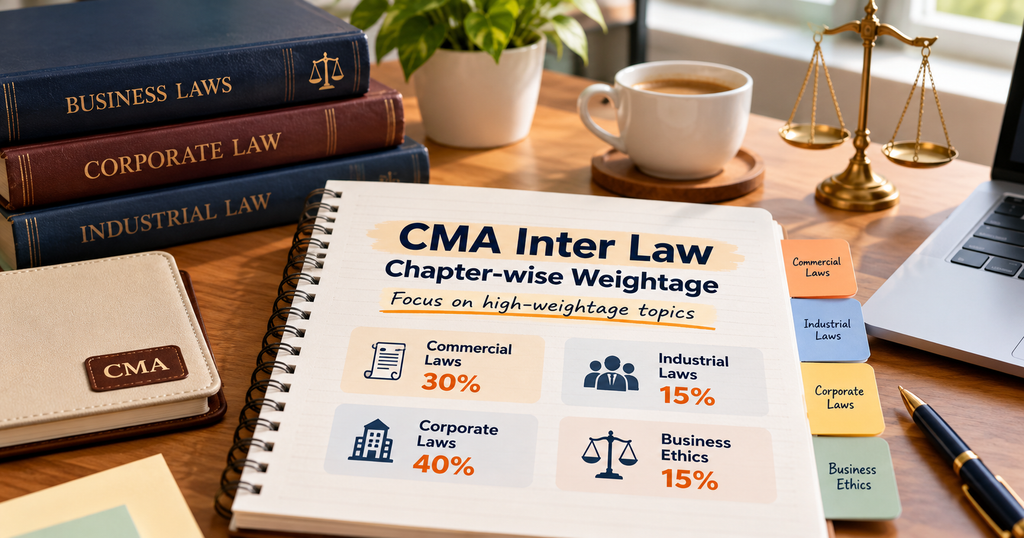
| Section | Topic | Weightage |
| Section A | Commercial Laws | 30% |
| Section B | Industrial Laws | 15% |
| Section C | Corporate Laws | 40% |
| Section D | Business Ethics | 15% |
The section which has the highest weightage is corporate laws.
Section A: Commercial Laws (30%)
Commercial Laws constitute 30 marks of the total exam paper.
1. Introduction to Law and Legal System in India (5%)
This chapter covers the basics of law and the Indian legal system.
Preparation Tip
Most of this chapter is theoretical in nature. Learn about legal terms and constitutional fundamentals.
2. Indian Contract Act, 1872 (10%)
This chapter holds great importance in the subject of Commercial Laws and has high weightage in examinations.
Preparation Tip
Practice lots of practical case-study type Qs to get acquainted with contract laws.
3. Sale of Goods Act, 1930 (5%)
This chapter deals with buying and selling transactions in relation to goods.
Preparation Tip
Make quick and relevant summary notes for warranty/condition and seller’s right topics.
4. Negotiable Instruments Act, 1881 (5%)
These are widely used financial documents in any business.
Preparation Tip
Learn about various features of negotiable instruments. Chapter 138 is very important for examination point of view.
5. Indian Partnership Act, 1932 (5%)
This chapter explains how to form and run partnerships.
Tip for Preparation
Prepare thoroughly regarding Rights, Liabilities & Duties of Partners as the subject is frequently examined.
LLP Act, 2008
Visit Unique Academy For Commerce for more CMA inter Updates
Section B: Industrial Laws (15%)
Industrial Laws comprise 15 marks in the exam and concern the welfare of employees and laws regarding workplace.
1. Factories Act, 1948 (10%)
This law comprises the maximum weightage amongst all Industrial Laws.
Tips for Preparation
Students must prepare about statutory provisions and numerical limitations provided in the Act.
2. Others (Industrial Laws) (5%)
The following industrial acts should be prepared by students:
Gratuity Act
Provident Fund and Miscellaneous Provisions Act
State Insurance Act
Wages Act (2019)
Tips for Preparation
Preparation for this chapter must include the objective, applicability, and one important provision of each of these Acts. It is not necessary to prepare all the provisions.
Section C: Corporate Laws (40%)
Corporate Laws carry the maximum weightage in the CMA Inter Law syllabus – nearly 40 marks.
This section mainly comprises the Companies Act, 2013.
Companies Act, 2013 (40%)
The chapter contributes the maximum number of marks. Hence, it deserves special attention during your studies.
Important Topics
Company formation
Share capital
Directors
Meetings
Accounts and audit
Corporate compliance
Preparation Tips
This chapter constitutes the crux of CMA Inter Law syllabus. Note down important provisions and then apply it to real-life examples of companies.
Section D: Business Ethics (15%)
Business Ethics can generally be considered a section which is high scoring and comparatively easy.
Business Ethics and Emotional Intelligence (15%)
The ethics in decision-making and business ethics for professionals have been covered in this chapter
Preparation Strategy
Understanding real-life examples is essential to comprehend ethics-related scenarios. This will help you to write descriptive answers.
Chapter-wise Preparation Strategy
To score well in CMA Inter Law, prioritize topics based on their weightage as follows:
Highest Weightage (40%)
• Companies Act, 2013
High Weightage (30%)
• Indian Contract Act, 1872
• Factories Act, 1948
Medium Weightage (15%)
• Business Ethics and Emotional Intelligence
Moderate Weightage (15%)
• Sale of Goods Act
• Negotiable Instruments Act
• Partnership Act
• Other Industrial Laws
• Introduction to Law
If students prepare the above-mentioned acts well, they can easily get close to securing almost half marks in the exam.
Conclusion: Understanding the CMA Inter Law Syllabus and Weightage
There is no need for rote memorization of laws in CMA Inter Law. Just understanding the core principles and their applications is what is required. Nevertheless, the key to scoring well in CMA Inter Law exam lies in understanding which chapters carry more weightage and preparing them accordingly along with other small chapters like Companies Act, Indian Contract Act, and Factories Act.
With a smart method of preparation, revisions, and answering previous year papers, you will score great marks in this subject for CMA Inter examinations.
Frequently Asked Questions About CMA Inter Law Syllabus and Weightage
The subject carrying the maximum weightage is Corporate Laws accounting for 40% of the entire paper through the Companies Act 2013.
Yes, it is an easy subject along with Emotional Intelligence, which is theoretical and quite understandable.
Yes, even though there is no weightage, you should be aware of the basics of LLPs.
Students are advised to give primary importance to the Companies Act, Indian Contract Act, and Factories Act and then go for others like Business Ethics and small chapters.
Yes, definitely. As long as students prepare well, they have the chance to score more than 60 marks.