
CMA Course in India — Everything You Need to Know Before You Start
The Cost and Management Accountant course is a three-level professional qualification run by ICMAI — Foundation, Intermediate, and Final — that builds expertise in cost control, budgeting, financial planning, and strategic business decision-making. This page covers the complete CMA course details: Cost and Management Accountant course fees, Cost and Management Accountant course eligibility, Cost and Management Accountant course duration, CMA subjects, and what a CMA salary in India actually looks like once you’re qualified.
Whether you’re asking how to become a CMA in India straight after 12th, comparing CMA online classes against offline coaching, or just trying to understand the full ICMAI course structure before committing, this guide covers the entire journey — not just one level of it.
● Free · No Card Needed
Talk to a CMA Counsellor
Fill the form & our team will call you within 24 hours.

What Is the Cost and Management Accountant Course, Really?
A Cost and Management Accountant (CMA) is a certified finance professional trained to look at the “inside” of a business — cost control, budgeting, performance analysis, and strategic decision support — rather than just external auditing and compliance. It’s a CMA course conducted entirely by ICMAI (the Institute of Cost Accountants of India), a statutory body established under an Act of Parliament in 1959, and it’s one of the more affordable Cost and Management Accountant qualification paths available directly after Class 12.
The course runs across three levels, each building on the last:
After clearing all three levels and completing mandatory practical training, candidates become eligible for ICMAI membership and the “CMA” designation itself.

Why Students Choose Unique Academy for CMA
One Academy, All Three Levels
Instead of switching institutes at every stage, students can stay with the same faculty and teaching approach from Foundation through to Final — useful given how directly the syllabus builds level over level.
Flexible Entry Points
Graduates can register directly for CMA Intermediate, skipping Foundation entirely — a genuinely faster route into the course for students who’ve already finished a degree.
Live, Recorded & Offline
Every level — Foundation, Intermediate, and Final — is available as live online classes, recorded lectures with unlimited watch time, or in-person batches at the Pune centre.
Structured Test Series at Every Level
Practice tests are built into the course at each stage rather than sold as an afterthought, aimed at closing the gap between understanding a concept and actually scoring well on a 3-hour, largely descriptive exam.
Most Students Underestimate the Real CMA Timeline
CMA has a reputation as one of the more “affordable and manageable” professional courses — which is broadly true, but that reputation sometimes leads students to underplan for the practical training component and the real study hours needed at Intermediate and Final.
Where Students Go Wrong
What Actually Works
Cost and Management Accountant Course Eligibility — Who Can Start, and When
Eligibility changes at each level of the course — here’s the breakdown for all three entry points.
-
Straight after Class 12 — Any stream (except fine arts) qualifies for CMA Foundation.
-
Graduates — Can register directly for CMA Intermediate, skipping Foundation entirely.
-
CAT-Qualified & 2nd-Year Degree Students — Also eligible for direct entry into Intermediate under ICMAI’s alternate routes.
-
CMA Intermediate Clearers — Must clear both groups of Intermediate before registering for CMA Final.
Registration Windows
CMA Subjects Across All Three Levels
Here’s what each level of the CMA course actually covers, subject by subject.
CMA Foundation
4 papers covering Business Laws, Fundamentals of Accounting, Mathematics, Economics, Statistics, and Business Communication. No negative marking; calculators allowed.
CMA Intermediate
8 papers across 2 groups. Group 1 covers Business Laws and Ethics, Financial Accounting, Direct and Indirect Taxation, and Cost Accounting. Group 2 covers Operations Management and Strategic Management, Corporate Accounting and Auditing, Financial Management and Business Data Analytics, and Management Accounting. 800 marks total.
CMA Final
8 papers across 2 groups, including one elective, focused on strategic financial management, corporate decision-making, advanced cost management, and business leadership topics.
What Does a CMA Salary in India Actually Look Like?
Salary figures for CMA professionals vary a fair amount by source, industry, and experience — here’s the honest spread rather than one cherry-picked number.
Fresher Salary
Roughly ₹4–10 LPA, depending on industry, city, and whether the role is PSU or private sector
PSU / High Performers
₹12–18 LPA starting packages reported at organizations like ONGC and IOCL
Mid-Career / ICMAI Placement Average
Around ₹10 LPA per ICMAI’s own 2023 Placement Report (highest recorded CTC: ₹19.7 LPA)
Senior / Leadership Roles
₹19.7–25 LPA+, with CFO-track roles going well beyond that over a full career
Career paths after qualifying: Cost Accountant, Finance Manager, Chief Financial Officer (CFO), Financial Controller, or roles across manufacturing, banking, consulting, IT, and PSU finance departments — CMA is particularly strong in manufacturing and PSU recruitment specifically, given its depth in cost accounting and cost audit, which few other Indian qualifications cover to the same level.
How to Become CMA in India — The Full Roadmap
A clear, staged path from Class 12 to ICMAI membership — here’s what the journey actually looks like end to end.

Step 1
Register for CMA Foundation
Or Enter at Intermediate as a Graduate

Step 2
Clear CMA Foundation
4 Papers: No Negative Marking, Calculators Allowed

Step 3
Clear CMA Intermediate
8 Papers Across Two Groups, 800 Marks

Step 4
Clear CMA Final
8 Papers Across Two Groups, Including One Elective

Step 5
Complete Training & Apply for ICMAI Membership
15 Months Practical Training, Then Use the “CMA” Designation
CA Roadmap
Register for CMA Foundation
Or Enter at Intermediate as a Graduate
Clear CMA Foundation
4 Papers: No Negative Marking, Calculators Allowed
Clear CMA Intermediate
8 Papers Across Two Groups, 800 Marks
Clear CMA Final
8 Papers Across Two Groups, Including One Elective
Complete Training & Apply for ICMAI Membership
15 Months Practical Training, Then Use the “CMA” Designation
Frequently Asked Questions
A Cost and Management Accountant is a finance professional trained specifically in cost control, budgeting, performance evaluation, and strategic decision support — essentially, the internal financial thinking that helps a business improve profitability and efficiency, rather than just externally auditing its books. Where a Chartered Accountant is typically associated with statutory audit and taxation, a CMA is trained to look at the “why” behind the numbers — helping a company plan budgets, control costs, and make better strategic calls. This makes CMAs particularly valuable in manufacturing, infrastructure, and other cost-intensive industries where controlling operational spend directly affects the bottom line.
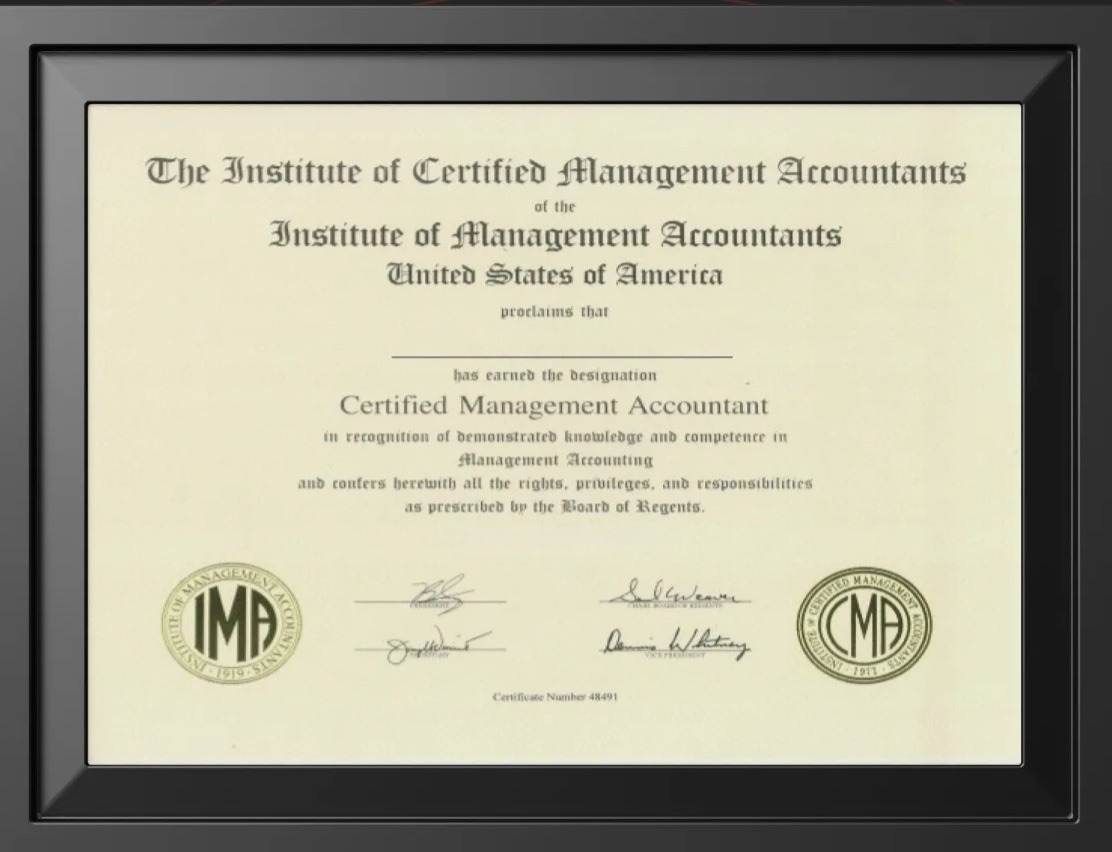
CMA stands for Cost and Management Accountant in the Indian context. The course is regulated entirely by ICMAI — the Institute of Cost Accountants of India — a statutory body established under an Act of Parliament in 1959, functioning under India’s Ministry of Corporate Affairs. It’s worth noting that “CMA” internationally can also refer to the US Certified Management Accountant credential offered by the IMA (Institute of Management Accountants) — a different, separate qualification with its own fee structure and exam format. This page covers the Indian ICMAI pathway specifically.
The standard starting point is CMA Foundation, open to any student who has passed Class 12 in any stream except fine arts. After clearing Foundation, you move into CMA Intermediate, then CMA Final, and finally complete 15 months of mandatory practical training before applying for ICMAI membership. If you’re already a graduate, you can skip Foundation entirely and register directly for CMA Intermediate instead — a meaningfully faster route for students who’ve already finished a degree.
For CMA Foundation, you need to have passed Class 12 in any stream from a recognized board. For CMA Intermediate, eligibility opens up to Foundation clearers, graduates in any discipline (except fine arts), and students who’ve cleared ICMAI’s CAT (Certificate in Accounting Technicians) exam or are in their second year of an engineering/degree program. For CMA Final, you must have cleared both groups of Intermediate — there’s no direct-entry shortcut into this final stage.
Most students complete the full journey — all three levels plus the mandatory 15-month practical training — in around 3 to 4 years from the time they start with Foundation after Class 12. Some sources cite a slightly wider realistic range of 3 to 5 years, depending on how quickly a student clears each group and whether any attempt needs to be repeated. Graduates entering directly at Intermediate typically finish somewhat faster, since they skip the Foundation stage entirely.
CMA Foundation covers four papers: Business Laws, Fundamentals of Accounting, Mathematics, Economics, Statistics, and Business Communication. CMA Intermediate covers eight papers across two groups, including Financial Accounting, Direct and Indirect Taxation, Cost Accounting, Operations Management, Corporate Accounting and Auditing, and Financial Management. CMA Final covers eight papers across two groups, including one elective, focused on strategic financial management, advanced cost management, and corporate decision-making. Each level builds directly on the cost-accounting and financial-management concepts introduced at the level before it.
ICMAI’s own registration and exam fees across all three levels typically total around ₹54,100 — roughly ₹6,000 for Foundation, ₹23,100 for Intermediate, and ₹25,000 for Final, based on current published figures. Including coaching, study material, and other incidental costs, the realistic all-in total for the complete CMA journey generally falls somewhere between ₹67,000 and ₹1.5 lakh-plus, depending on the coaching combination chosen. It’s worth checking ICMAI’s current official fee notification directly before budgeting, since these figures are periodically revised.
Fresher CMA salaries generally range from ₹4 to ₹10 LPA depending on industry, city, and whether the role is in the private sector or a PSU. According to ICMAI’s own 2023 Placement Report, the average package for placed CMA-qualified students was around ₹10 LPA, with the highest recorded CTC at ₹19.7 LPA. High-performing candidates joining PSUs like ONGC or IOCL have reported starting packages of ₹12–18 LPA. As with most professional qualifications, published salary ranges vary a fair amount across different sources — the honest takeaway is a range, not one fixed number, and it’s worth checking ICMAI’s most recent placement data for the most current figures.
CMA is generally considered one of the more affordable and time-efficient professional courses compared to CA, with a shorter practical training requirement and a syllabus that many students find more approachable in the earlier stages. It’s particularly strong for students specifically interested in cost management, manufacturing finance, and industrial accounting — no other Indian qualification goes as deep into cost accounting and cost audit as CMA does, which is exactly why PSUs and manufacturing companies specifically recruit CMA-qualified professionals for finance roles. That said, CA tends to carry stronger brand recognition for statutory audit and Big 4 roles, and CS is more specifically governance-and-compliance focused — the “best” choice really depends on which specific finance function a student wants to build a career in.
Qualified CMAs typically move into roles like Cost Accountant, Finance Manager, Financial Controller, or eventually Chief Financial Officer (CFO), across industries including manufacturing, banking, consulting, IT, and healthcare. CMA is particularly well-represented in PSU finance departments and manufacturing-sector roles, given the qualification’s depth in cost control and cost audit work. Global firms like EY, KPMG, HUL, ITC, and even startups have also been reported hiring CMA-qualified professionals into corporate strategy, risk, and financial control roles, reflecting the qualification’s growing relevance beyond traditional cost-accounting functions.
As part of qualifying as a CMA, ICMAI requires candidates to complete around 15 months of mandatory practical training, gaining hands-on exposure to cost accounting, financial management, and auditing work in a real organizational setting. This training requirement exists alongside the exam stages and is a mandatory prerequisite for ICMAI membership — clearing all three exam levels alone isn’t sufficient without also completing this training component.
Yes, the CMA course can be studied entirely online — live classes with recorded backup are available at every level (Foundation, Intermediate, and Final), and offline batches are also available for students who prefer in-person instruction at a physical centre. Many students mix formats depending on their situation — attending live sessions when their schedule allows, and relying on recorded lectures with unlimited watch time during exam-heavy periods or while balancing studies with other commitments.
There’s a real advantage to staying with one academy across Foundation, Intermediate, and Final, mainly around consistency in teaching style and faculty familiarity with a student’s specific weak areas as the syllabus gets progressively harder. It’s not a strict requirement, though — some students switch institutes between levels if they feel a different teaching approach or faculty specialization would suit the more advanced Intermediate or Final material better. The right call depends on what’s actually working for that specific student.
For students genuinely interested in cost management, financial planning, and strategic business decision-making — rather than purely statutory audit or governance work — CMA tends to offer a very strong return on investment. Total course fees are relatively low compared to many alternatives (well under ₹1.5 lakh in most cases, versus significantly more for an MBA at a top-tier institute, for comparison), while starting salaries in the ₹4–10 LPA range with a clear path toward CFO-level roles make the cost-to-outcome ratio genuinely compelling. It’s especially strong for students specifically targeting manufacturing, infrastructure, or PSU finance careers, where CMA’s cost-accounting depth is hard to match with any other Indian qualification.
Start Your CMA Journey Today
Free counselling to help you figure out exactly where to start — CMA Foundation, direct entry into Intermediate, or picking up where you left off.
or call us directly — 8007916622